Saturday, 6 February 2016

Ships and Pirates on the Ancient Seas - a Panoply Interview with Dr Philip de Souza

Today we’re talking to Dr Philip de Souza, Senior Lecturer at University College Dublin. An expert in ancient naval warfare, Philip’s publications include Piracy in the Graeco-Roman World (1999), and Seafaring and Civilization: Maritime Perspectives on World History (2001), with Ancient Naval Warfare coming soon, along with an edited volume, (with Robert Hohlfelder and Boris Rankov) The Oxford Handbook of Seafaring in the Classical World. Philip is also a special friend of Panoply having supervised Sonya’s doctorate and having seen all our animations from day one. Today he chats to us about ancient vase-scenes of ships, and pirates - curse of the high seas…


1. When do depictions of ships on vases begin?
They probably begin around 3100BCE, with some sketchy images on prehistoric Egyptian vases. The earliest depictions of sails seem to date from about this time. In the Greek world vessels with oars and sails are depicted on a variety of Mycenaean objects with some very clear ones dating to around 1700BCE.

2. To what extent are vase paintings of ships stylized or realistic?
I think it’s a bit of both. There are some obviously stylized depictions, such as the early Greek depictions of “double-decker” oared ships from c.700BCE, which in fact seem to be trying to show the oarsmen on both sides of a ship in profile. There is a good example on a Theban krater in the British Museum. Realism was certainly possible, and some black figure painters seem to be consciously trying to represent features of sailing ships and galleys accurately by the late sixth century BCE, although it seems to me that when a boar’s snout is depicted on a ship’s prow it’s more likely to be an artistic embellishment than an authentic detail. There is also the likelihood that some unusual features are the result of indifferent artistry. My favourite in this category is the so-called Aristonothos krater, a South Italian piece of painted pottery dated to c.650BCE. It features two ships with warriors on them, one of which has a very oddly shaped prow. The image has encouraged several scholars to develop elaborate theories of local ship design, but when I look at it all I see is a poor attempt to sketch a standard prow on the curving surface, done by an obviously inept artist who was not at all concerned about realism.

Above, double-decker oared ship as depicted on a spouted krater from Thebes, c.700. British Museum, 1899,0219.1

Above, The Aristonothos Krater, Capitoline Museum, Rome

Aristonothos Krater, both sides, drawing by Natacha Lubtchansky.

3. How do ancient images of ships help you in your research?
Images of ships are essential for the study of ancient seafaring. They tell us a great deal about the design and operation of seagoing vessels. The reconstruction of a Classical Athenian trireme, Olympias, could not have been undertaken without key pieces of information provided by ancient images. They also tell us a lot about what people thought about ships and seafaring. It is noticeable that, while triremes were vital to the Classical Athenians’ military activities, they seem to have featured only very rarely in public art. In contrast, there are quite a lot of images of ships in the surviving public art of the Roman Empire, in spite of the conventional view of the Romans as landlubbers.

4. Was piracy a big problem on the ancient Greek seas?
It was for those on the receiving end, but what Professor Vincent Gabrielsen has dubbed “the raid mentality” was an integral part of Greek warfare, so seaborne raids for plundering were commonplace, and almost a way of life from Homeric times onwards. The two Greek words that are usually translated as “pirate” are leistes and peirates, but neither is used exclusively for seaborne armed robbers. Leistes appears in the Homeric poems, composed c.700 BCE, and essentially means a “raider”, although it is noticeable that none of the Homeric heroes is ever called a leistes. When city-states with large armed forces emerge in the Greek world the word is used for raiding in warfare, by land and sea, but it becomes a pejorative term, often applied to the activities of political opponents in order to delegitimize them and justify military action against them. Peirates appears only on the 4th century BCE as a synonym for leistes, by this time seaborne raiding is widespread and the distinction between legitimate warfare and illegitimate “piracy” is very hard to establish. The Romans adopted peirates into Latin as pirata, from which we get “pirate” using it exclusively for seaborne raiders whose activities were deemed illegitimate by the state. Rome’s conquest of the Mediterranean reduced the problem considerably because wars were far less frequent and their standing armies and fleets could quickly suppress outbreaks of piracy.

5. Is there any way to tell if a vase shows pirates rather than other types of sailors?
Not definitively, because in Antiquity “pirate” was a subjective label, one that people applied to others to delegitimize them. No-one ever declared themselves to be pirates and there are images that might be interpreted as piracy – e.g. an Athenian black figure vase in the British Museum that seems to show a small galley attacking a merchant vessel – but none that are necessarily depictions of piracy.

Above, a galley ship attacks a merchant vessel, on a krater from Athens, c.500. British Museum, 1867,0508.963

Above,some anti-social behaviour at sea, from a black-figure vase c.490-480 (National Museum of Athens, NM487), drawing by Hans van Wees

6. Do you have a favourite story about ancient seafaring?
My favourite story is the one about Alexander the Great and the pirate in book 4 of The City of God, by St. Augustine. Alexander supposedly asked a captured pirate, “How dare you molest the sea?” “How dare you molest the whole world?” the pirate replied. “Because I do it with a little ship only, I am called a pirate. You do it with a great army, and so you are called an emperor”. That anecdote has both a political and a philosophical message, and it shows us that the ancients could be every bit as sophisticated in their analysis of the dynamics of power as modern political theorists. Noam Chomsky used the story as the starting point for a whole book about the hypocrisy of modern western states’ attitudes to “terrorism”. There’s a very sharp cartoon based on it that you can find on Youtube (and below).


Many thanks to Dr de Souza for all this fascinating info. Keep your eyes open for ships next time you’re hitting the museums, and check-out Seafaring and Civilization: Maritime Perspectives on World History to find-out more. In the meantime, enjoy Pirates and Emperors:


Above, Pirates and Emperors.

Thursday, 17 December 2015

The Force Awakens New Greek Vase-Scenes

Myth is malleable. Myth is fun. Myth is thought-provoking. No surprise then that in every generation artists turn to myth for inspiration. This post is dedicated to a whistle-stop tour through art inspired by a two-fold love of ancient Greek vases and Star Wars. Yes, celebrating the release of Star Wars: The Force Awakens, we’re looking at the modern myths of Star Wars as channelled through that classic art-form, the vase scene. If we’ve missed one you love, feel free to post it in the comment section. This post contains no Force Awakens spoilers, but plenty for parts I-VI.

Above, Vader vs Luke, by Wharton.

We begin with this fabulous combat scene by Wharton, a designer at designbyhumans.com. It gives us the monumental fight between Darth Vader and Luke Skywalker, channelling the famous Rhodian plate:
Above, the Rhodian plate, Trustees of the British Museum, BM 60. 4.4-4.1

Wharton has captured the lay-out nicely, including the additional features that fill the space around the main figures. The Greek plate, made on the island of Rhodes in the late 7th century, features Menelaus (left) and Hector, fighting over the body of Euphorbus. The decorator has captioned the figures to make sure we know who they are. Book 7 of the Iliad describes the action. Menelaus ran to protect the body of Patroclus when he saw him die; Euphorbus tried to win the body back so he could strip its valuable armour. Menelaus stood over Patroclus ‘as a mother-cow stands over her first calf’, and killed Euphorbus, ‘stabbing him in the base of the throat… through his soft neck.’ Hector ran to protect the body of Euphorbus. The Rhodian plate shows them sizing each other up for the fight. The Iliad describes Menelaus backing away, as he knows Hector is the better fighter. In vase iconography, the winner is usually depicted on the left of the scene. Wharton has echoed that effectively by placing Vader on the left, with Luke on the right, even though the Rhodian plate has Menelaus on the left. Vader and Luke have been given shields to up their Greekness. They should perhaps be holding their light sabres as spears, but instead we see them fighting with light-sabre-like leaf-blade swords. Still, a nice piece of work that makes sympathetic use of the ancient lay-out and a simple palette.

Above, Vader vs Yoda, by Andre Minoru Asai

This next piece you might recognise from an earlier post on vase-remixes. It's by Brazilian-based Andre Minoru Asai, aka. asaifactory. The image has less detail than Wharton’s piece, but what it lacks in tie-fighters, it makes up for in clarity of vision. We’ve got the intense orange and black contrast that we know and love from Attic pottery, and a Greek key of death stars and droids across the top and bottom. In the Star Wars films, Yoda and Darth Vader never fight each other, but vase remixes, like ancient vases, can play around with myth, making tweaks and changes as the artist sees fit.


Above, Hoplite Bobba Fett and Cyclops Vader, by Aaron McConnell.

The next two pieces are a bit different, really going to town merging Star Wars characters and ancient features in an illustrative style that draws on Greek vase scenes. The hoplite-like helmet of Bobba Fett’s Mandalorian panoply is really brought out in this drawing. (A topic we’ve looked at in a previous Star Wars post). The Cyclops Vader is really inspired – myth lovers will remember that the Cyclops Odysseus encounters, Polyphemus, is a shepherd who lives with his flock of obedient sheep.
Above, space sheep.
Artist Aaron McConnell has done a whole set of these. You can find more of them on his site: http://aamcconnell.com/2015/05/05/greek-star-wars/

Above, Luke waits for adventure, by Ace Techne.

This sweet scene by Hapo (aka Ace Techne) also uses an illustrative style. We have a bit more shading and a sense of perspective that we wouldn’t expect on a vase, but on the other hand, we also have the unmistakable take on the reddy-orange and black colour scheme, and a Greek-key-like frame around the scene. Hapo has steered clear of the combat-scenes and opted for the pastoral scene of the young farm boy biding his time waiting for adventure. What’s that? You wanted to go to Tosche Station to pick up some power converters? Too bad, Luke, too bad.

Above, Vader vs Luke, by Antium.

Above, Achilles vs Penthesilea, by Exekias, trustees of the British Museum, BM 1836.0224.127.

This is our last example, a splendid piece of work by Antium, depicting the moment that Vader cuts off Luke’s hand. Antium has gone explicit with the vase theme by placing the scene on a vase background. The image is also explicit about where in the Star Wars saga this comes from, with the V for Episode V (The Empire Strikes Back) on the neck. The attention to detail in the figures’ armour and clothing is marvellous, and very in-keeping with the style of Exekias, the master vase-painter who has been imitated. The dynamic of raised victor, lower loser has also been replicated, as we can see by comparison with Exekias’ Achilles-Penthesilea. So too has the eye contact. Achilles-Penthesilea lock eyes in a slightly creepy erotic dying scene, while Luke looks reproachfully at Vader, perhaps finding it difficult at that moment to see the good in him.

You’ve seen a few examples. What scene would you re-work?

The Force Awakens poster, by Matt Needle.

An update to include this actual real Star Wars tea-pot, made for Mai Musie, Classics Outreach Officer at the University of Oxford. Thanks for sharing Mai!:

Tuesday, 10 November 2015

Electra, Ancient and Modern. A Panoply Interview with Dr Anastasia Bakogianni

Today we’re talking to Dr Anastasia Bakogianni, Visiting Fellow at the Institute of Classical Studies, and formerly a Lecturer at the Open University. A leading light in the understanding of the impact of antiquity on later ages, Anastasia is the author of Electra Ancient and Modern: Aspects of the Reception of the Tragic Heroine and the co-editor of the newly released War as Spectacle: Ancient and Modern Perspectives on the Display of Armed Combat. We caught up with Anastasia following her return from a successful research trip to Brazil, to talk to her about Electra, murder, and sibling affection...

1) Who is Electra?
Simply put Electra is the daughter of King Agamemnon (of Trojan War fame) and Clytemnestra, and the sister of Orestes. You see in ancient Greece a woman tended to be defined in terms of her birth family. Her parents and sibling are much more famous in Greek epic and lyric where she is just a minor character. In Greek tragedy, however, Electra takes centre stage. She becomes a key player in the dramatic plots about her troubled family and a shockingly transgressive female character. She is the chief mourner of her father, in process becoming closely associated with the act of lamentation. Crucially, Electra also aids her brother in carrying out his plans for vengeance against their mother Clytemnestra and her paramour Aegisthus. They murdered Agamemnon upon his return from the war and dispossessed Orestes. He returns after many years to reclaim what is rightfully his and to avenge his father. The vagaries of textual survival mean that Electra is unique in the Greek tragic corpus because we have her treatment by all three Greek tragedians. She features in Aeschylus’ Choephori (part of the famous Oresteia trilogy, 458 BCE) and is a principal character in Sophocles and Euripides’ Electra plays (the former is dated between 420 and 410 BCE, while the latter to 422-413 BCE). She is also an important character in the latter’s Orestes (408 BCE). What has fascinated later generations of artists and audiences about Electra is her passion for revenge and the lengths to which she will go.
Above, Orestes and Electra at the tomb of Agamemnon, as shown on an Athenian white-ground lekythos, 460-440 BCE.© The Trustees of the British Museum

2) Does Electra appear on any ancient Greek vases?
She certainly does, but not as an avenger. She was most often portrayed as a mourner at the tomb of her father (as in vase above), but it was the theme of her meeting with her brother Orestes that captured the imagination of fourth-century vase painters, especially in southern Italy. Athenian potters tended to avoid portraying scenes from tragedy, but south-Italian potters had no such compunctions, and a number of vases featuring Electra from that region survive. Here are two particularly fine examples:

Above, Scene at Agamemnon’s tomb. Orestes and Pylades encounter a mourning Electra. Campanian red-figured hydria, 350-320 BCE. © The Trustees of the British Museum

Above, probable meeting of Orestes and Electra, on an Apulian red-figured bell-krater, 375-350 BCE. © The Trustees of the British Museum

I particularly like the image directly above, which is (probably) of Electra on a stripped pillow, shown on a bell-krater (a large vase used for the mixing of wine and water). Her head is veiled as it often is on vases, and her right hand is raised ready to push her veil forward, perhaps as a sign of her modesty when confronted with an unknown male. This suggests that she has not yet recognised her brother. Behind her on the right is her sister Chrysothemis (? probably). Her inclusion is an interesting feature as Chrysothemis appears on stage only in Sophocles’ drama and she never actually meets Orestes in our surviving source texts. Her presence and the lack of a funerary monument indicate that this bell-krater is not actually modelled on any particular play. Rather it is (possibly) an imaginative depiction of a well-known story.

3) Are there any pitfalls in looking for Electra in vase scenes?
Yes! that is precisely the danger in consulting vase scenes when researching Electra as a tragic heroine. The images of Electra we find on ancient artefacts (which include not only vases, but also gems, reliefs etc.) are usually not directly related to her portrayal in the plays of Aeschylus, Sophocles and Euripides. Ancient artists did not feel the need to remain faithful to the plot of the tragedies in which she appeared, but reimagined her in positions and scenes that they hoped would appeal to the ancient consumers of their wares. That is why Electra’s vengeful feelings are not a prominent feature of her portrayal on vases. After all who would want to buy a vase depicting a daughter who ardently desires her mother’s death? There is a possible exception to this rule, but we are not 100% sure it shows us Electra. This possible depiction of Orestes’ matricide includes a female figure on the right-hand side, but we cannot positively identify it as Electra.

Above, Orestes killing Clytemnestra (?), Attic red-figured stamnos, 480-460 BCE. © The Trustees of the British Museum.

All these question marks also reveal how difficult it is even for experts to positively identify scenes on ancient vases.

4) How have you used these vase scenes in your research?
One must therefore approach vase scenes and other material culture evidence with a certain amount of caution. They do testify to the ways in which Electra was depicted inancient visual culture, but it is a mistake to try and directly link them to her portrayal in Greek tragedy. The best way to handle them is as yet another facet of Electra’s long reception history. These images also signal to us which aspects of the tragic heroine were considered too transgressive for depiction in ancient art. Electra’s dark passion for revenge, so prominent particularly in Euripides and Sophocles’ tragedies, is entirely absent from our surviving images of her in ancient art. Electra can be a witness to her brother’s act of matricide (if that is the correct identification of the scene on the Attic stamnos, above), but she cannot be an active participant. In any case this image is in effect a visualisation of the behind-the-scenes spaces of Greek tragedy. Violence usually took place off stage and was vividly reported by a messenger on stage. The closest Electra comes to taking direct action in the surviving dramas is in Euripides’ Electra where she tells the audience that her hand was on Orestes’ sword when he killed their mother (lines 1224-25).

Above, relief depicting the meeting of Orestes and Electra at the tomb of Agamemnon. Greek, 5th century BCE, Louvre, Paris, France, Nationality/copyright status: Greek/out of copyright.

5) As the title of your book reminds us, Electra has remained an important figure in art and culture after antiquity. How similar are the ‘modern’ Electras to ‘ancient’ Electras?
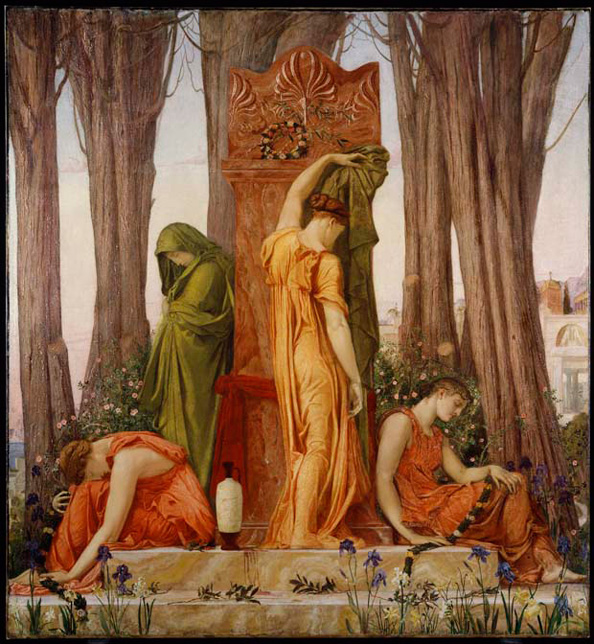
This trend in the reception of Electra in the visual arts continued in the post-classical era, too. You could call it the whitewashing of Electra’s darker side. In the visual culture of the 18 and 19th centuries Electra becomes the mourner par excellence of Greek tragedy. As in classical antiquity her meeting with her brother at the tomb of their father also continued to be depicted as it emphasises the heroine’s devotion to the patrilineal side of her family. In Britain, John Flaxman, Lord Frederic Leighton and Sir William Blake Richmond created powerful and enduring images of Electra captured in the act of mourning.

Above, Flaxman’s Electra mourning (1795) and Electra and Orestes recognition scene (1795) © British Library Board.
Above, Lord Frederic Leighton’s Electra at the tomb of Agamemnon (exhibited in 1869), Ferens Art Gallery.
Above, William Blake Richmond, Electra at the tomb of Agamemnon (1874), Art Gallery of Ontario, Canada.

In the 20th century, Electra begun to regain some of her darker aspects. As well as a mourner she once more became the heroine who passionately demanded vengeance, even at the cost of matricide. She also starred on the silver screen, for example in Michael Cacoyannis’ film Electra (1962).
Above, Electra at tomb of Agamemnon from Electra (1962). Photo courtesy of the Michael Cacoyannis Foundation.

In the 20th century, Electra also raised her powerful voice against oppression everywhere. In Miklós Jancsó’s movie Szerelmem, Elektra (Electra, My Love, 1974) the heroine becomes a symbol for revolution, dies and is repeatedly reborn. And these are far from Electra’s only incarnations in modern media.

6) Is she more often a mourner or a matricide?
Electra’s reception is characterised by her dual function as both mourner and matricidal daughter. The two are inseparable in Greek tragedy, but receive different degrees of prominence in different stages of her rich afterlife. Sometimes, for example in eighteenth-century British visual culture, her function as mourner subsumes her vengeful feelings. But that was chiefly because during this period women were viewed as creatures of emotion. Ancient women were often depicted as models of correct female behaviour, so it was not appropriate to portray a daughter who passionately desires the death of her mother. Instead we have the dutiful daughter who mourns her father and is a loyal and devoted sister. In later centuries artists gradually laid claim again to the full spectrum of Electra’s character including her darker aspects. In the performing arts in particular Electra’s passionate cries were heard once again thanks to our modern fascination with psychoanalytical theories. Freud and Jung made the dark side of Electra fashionable again.

7) What were you researching in Brazil?
As it happens I was gathering material about a Brazilian incarnation of Electra. I keep saying that I won’t work on Electra anymore, but then I discover yet another exciting reception of my favourite tragic heroine and I get pulled back in. And this is a particularly dark version of the tragic heroine. There is murder, suicide, incest and much more in Nelson Rodrigues’ Lady of the Drowned (1947). This is a play in which Electra has turned to the dark side before the curtain even opens. But I won’t say any more here as this is a drama that showcases surprising revelations and dark secrets exposed!

8) Who’s your favourite ancient Greek?
Electra, without a doubt will always come first with me, but I am also fascinated by other transgressive tragic heroines such as Antigone, Clytemnestra, Hecuba and Medea. Greek tragedy is a genre famous for its ‘bad’ women. But then again they are so much more interesting than ‘obedient’ women such as Alcestis who chooses to die in her husband’s place in Euripides’ eponymous play (438 BCE). The transgressive women of Greek tragedy also enjoyed much more interesting afterlives and have tended to attract more attention by later artists. Who after all can take their eyes off Medea as she vacillates on stage between her anger and her maternal feelings? Or fail to be both fascinated and repulsed by Hecuba’s bloody act of vengeance in Euripides’ drama that bears her name (c. 424 BCE)? And who could refuse to be drawn in when Electra’s passionate cries are heard in theatre, opera and cinema? It is perhaps a symptom of our turbulent and troubled world that these days we seem to be more drawn to anti-heroes and heroines, flawed, conflicted characters that face terrible dilemmas. And Greek tragedy is full of this type of dramatic personae, which goes a long way towards explaining its current appeal.


Many thanks to Anastasia for sharing these insights. You can find out more about this subject in her book, Electra, Ancient and Modern . You might also enjoy hearing Anastasia talk further about Electra in a short Classics Confidential video:


You can also hear Anastasia chatting with me about the modern use of ancient Greek tragedy as an anti-war spectacle, the subject of her chapter in War as Spectacle:

Tuesday, 3 November 2015

Animating Ancient Warfare – New Publication


Panoply are delighted by the release of War as Spectacle: Ancient and Modern Perspectives on the Display of Armed Combat.

This new collection explores the ways in which the ancient world treated conflict as a show, a performance, and how that has impacted on ideas about combat in the modern world.

This brief trailer will give you a taste:


Panoply make animations for the modern world that are powered by ancient depictions of the ancient world; and of course, this has included plenty of scenes of warfare, in animations such as Amazon, Well-Wishers, Combat, and the monster Hoplites! Greeks at War. In my chapter for War as Spectacle, I talk about how we interpreted the ancient material and about the decision making process we went through in creating a ‘spectacle’ for modern audiences. You can hear me chatting about some of these themes in this interview with War as Spectacle editor, Dr Anastasia Bakogianni:


Anastasia has also contributed a chapter to War as Spectacle, on her research specialism, the reception (i.e. life after antiquity) of Greek tragedy. Anastasia’s chapter focuses on the films of Michael Cacoyannis, and how he used Greek tragedy to express anti-war ideas:


With a fascinating twist that is typical of War of Spectacle, another chapter show how – at the same time as Cacoyannis was protesting against war - other people were busy using spectacles of ancient warfare to prop up their militaristic agenda.

Other chapters include:
'What if We Had a War and Everybody Came?': War as Spectacle and the Duel of Iliad 3, by Tobias Myers

'The Clash of Weapons and the Sight of War': Spectatorship and Identification in Roman Epic, by Neil W. Bernstein.

'The Greatest Runway Show in History': Paul Violi's 'House of Xerxes' and the Herodotean Spectacle of War, by Emma Bridges.

Epic Parodies: Martial Extravaganzas on the Nineteenth-Century Stage, by Justine Mc Connell.

You can order the book or find out more about it at:
http://www.bloomsbury.com/uk/war-as-spectacle-9781472522290/
Students, you can request books through your university library.

There's also a review available by ancient warfare doctoral candidate Own Rees in Classics for All Reviews.

Hope you enjoy it!

We'll hear more from Anastasia soon, in an exclusive interview about the mythical heroine, Electra. Watch this space :)

Monday, 5 October 2015

Animation Launch for ‘Bad Karma’

We have pictures for you from the recent launch of ‘Bad Karma’ at the UCD Classical Museum in Dublin. Visitors gathered to see the animation for the first time and to congratulate the two winners of the Irish Schools’ Storyboarding Competition.

Above, L-to-R, Steve Simons (Panoply animator), Sonya Nevin (Panoply), Winners Frank O’Grady and Eamonn O’Broin of Gonzaga College, Jo Day (Curator), and Ian Maguire (Chair of CAI-T, the competition sponsors).

Above, Steve meets a proud mother of one of the competition winners

Above, visitors gather in the museum for a large scale projection of the animation..

Above, Chair of the Classical Association of Ireland – Teachers, Ian Maguire, presented winners Eamonn and Frank with certificates..

Above, the tablet featuring Bad Karma and The Procession alongside the vase they were made from.
Above, museum curator Dr Jo Day chats to UCD Registrar, Prof. Mark Rogers about the collection.

Above, the launch featured an exhibition which included a shortlist of storyboards entered into the competition and details of the animation process.

Above, visitors enjoyed a drink and a chat as they explored the collection.

Many thanks to everyone who attended and to all those who supported the competition. Special thanks to Museum Assistant Aoife Walshe who organised the evening. Aoife was also part of the MA class who planned The Procession.
There is more about the animation and the vase it was made for on its webpage: http://www.panoply.org.uk/nike.html, and of course we recommend a visit to see the vase itself at the museum.

Wednesday, 16 September 2015

New Animation, New Interview

The new academic year is here. Whether you’re new to the Panoply site or a returning friend, you might find inspiration for teaching with vase animations in our latest publication: ‘Animations of Ancient Vase Scenes in the Classics Classroom’, in the Journal of Classics Teaching, which can be accessed for free via this link: http://dx.doi.org/10.1017/S2058631015000057. Our Animation Uses page is full of ideas too.

We’ll have a new animation for you soon. Steve has been working hard turning the winning storyboard from the Irish Schools’ Storyboarding Competition into a fully-fledged animation. Winners Eamonn O’Broin and Frank O’Grady of Gonzaga College Dublin will see their story launched at a special event in the UCD Classical Museum. The event is free and open to the public, come along if you’re in the Dublin area! (Thursday 24th Sept. 5.30-7.30pm, presentation at 6).


The new animation will join The Procession on display with the vase they’re made from.

Next month we have a new publication out. ‘Animating Ancient Warfare: The Spectacle of War in the Panoply Vase Animation’ will be appearing in a fantastic collection: War as Spectacle: Ancient and Modern Perspectives on the Display of Armed Conflict. War as Spectacle explores the display of armed conflict in antiquity and the many ways in which ancient warfare has been represented in later ages. My chapter looks at the process and decisions involved in representing ancient warfare in Hoplites! Greeks at War, Clash of the Dicers, Well-Wishers, and Amazon.

War as Spectacle editor and long-time friend of Panoply, Dr Anastasia Bakogianni, caught up with us to record an interview about hoplites and the spectacle of war. You can get the inside scoop here:


Sonya’s interview for Classics Confidential

Thursday, 20 August 2015

Magic and Play. A Panoply Interview with Véronique Dasen

Welcome to the start of a new academic year :) You have two new Panoply vase animations to look forward to, which will be out later this month and next.

Today we’re talking to Professor Véronique Dasen, Associate Professor of Classical Archaeology at the University of Fribourg in Switzerland. Prof. Dasen talks to us about her work on magic and amulets and about her exhibition, Veni, vidi, ludique (Came, Saw, Playful) to which Panoply contributed Clash of the Dicers.


1) Veni, vidi, ludique has been a magnificent undertaking, exhibiting in three Swiss museums across two years. What is the main aim of the exhibition?
Veni, vidi, ludique is an Agora project, supported by the National Swiss Foundation. Its aim is to promote the communication of scientific research to a wide audience. Veni, vidi, ludique shares the results of the latest research on games and toys in antiquity. Ludic practices (that is, activities to do with play) present important material and intangible cultural heritage that has long been neglected. Games and toys provide a wealth of information on stereotypes of gendered roles (such as dolls for girls, carts for boys), religion (toys and rites of passage; games and divination), adult/child relationship, educational principles, and more generally models of socialisation and transmission of cultural values. In an anthropological perspective, they engage wider reflections on our present society.

Above, the play area in the exhibition, 'Clash' plays in the cinema at the far end.

Above, Prof. Dasen discuses some of the artefacts with visiting young people.

2) The exhibition began in the Roman Museum of Nyon, moved to the Swiss Museum of Games in La Tour-de-Peilz, and is now at the Roman Museum of Vallon. Has being in different museums changed the way that the exhibition is displayed?
Each museum develops another aspect of the ancient sources and artefacts. The three museums share the same common title: Veni, vidi, ludique, and a common design, but each has a distinct subtitle according to its focus. The Musée romain of Nyon presented 'Le jeu de la vie', a general synthesis on the role of toys and games in the life cycle, from birth to adulthood. At la Tour-de-Peilz, Swiss Museum of Games, 'Jouer avec l’Antiquité' investigated the reception of Antiquity in modern games, from cards to videogames. At Vallon, Musée romain, 'Les jeux sont faits' reconstructs the games found during the excavation of the Roman villa, suggests rules, and invites the public to play and to test them.


Above, posters for each of the different legs of the exhibition.

At each place, interactivity is promoted by events, such as 'Cafés scientifiques', and by new technologies, such as a smart-guide for mobile phones with QR codes providing extra information, Panoply’s Clash of the Dicers vase animation, and table touch animations that enable visitors to understand the rules of ancient games. We also created a series of short movies providing reconstructions of games that visitors enjoy because of the bonding it creates. On our website www.venividiludique.ch, and below, you can see how Penthelitha was played in Antiquity.


3) Clash of the Dicers is made from Exekias’ vase depicting Achilles and Ajax gaming. What can we learn from that vase about games and play in antiquity?
This famous vase is one of the earliest of a large series (around 160) produced during 50 years at Athens under the reign of the Peisistratid dynasty. The scene reflects archaic aristocratic ideology. The heroes are two friends, the best Greek warriors. I call it a metaphoric icon*, demonstrating their capacity to concentrate, and to develop strategies. The game, identified as pente grammai**, however, is played with a dice, showing that success or defeat does not only depend from the personal qualities of the heroes, but also from the will of the gods.

* as discussed in V. Dasen, 'Achille et Ajax : quand l’agôn se mêle à l’alea', Revue du Mauss, in press.
** U. Schädler, 'Pente grammai – the Ancient Greek Board Game Five Lines', in J. Nuno Silva (dir.), Board Game Studies Colloquium XI, Proceedings, Lisbon, 2009, p. 169-192.

Above, Clash of the Dicers plays in a small cinema within the exhibition.

4) How have people responded to the animation?
Visitors of all ages enjoy the animation. It helps understanding how ancient imagery functions. The condensed image of Exekias is deconstructed in the movie revealing the different sequences that it concentrates. The vivid reactions of these legendary heroes, displaying their feelings, like modern players, make them familiar. However, the educational function of games was the opposite, to learn how to control your emotions! The lively music adds a humorous touch.

5) What other sorts of games and play can be found on ancient vases?
A large range of games are found on Greek vases, but not all. Vase-painters often focus on a specific age category, that of youths before marriage. An erotic tension is present, as ludic activities, such as ball games, allow the interaction of girls and boys. Some games are fascinating because they have disappeared today, such as ephedrismos, a type of “piggyback” game, always played between youths of the same sex because of the physical proximity it creates (see the special issue of Archeothema 31, 2013. Some games look familiar but their rules differ from today, such as the morra game, a hand game played holding a stick in ancient Greece. Its aim differs from the modern one that was traditionally played for money; Greek vases display a game of love and chance: a seducing girl is often opposed to a handsome boy, in the presence of Eros and Aphrodite.

Above, ephedrismos: a classical vase scenes shows young men playing the game.

6) You recently published your research on magic and amulets in antiquity in The Materiality of Magic. Was magic a big part of life in ancient Greece?
Yes! Magic, as a response to the hazards of daily life, was omnipresent. The frontier between game and divination is very thin. For example, we know that in Asia Minor five knucklebones were used as dice to produce oracles. A series of Roman period inscriptions have kept the results of the throws (56 combinations). We created an App, that can be freely downloaded from App Store, where you roll 5 knucklebones and discover the fate that awaits you. As in Antiquity, the oracle can be kept, but today you send it to yourself as an email. A second try is possible if the first result is too bad!

The knucklebones have four sides producing four numbers: 1, 3, 4, 6.
Here are two examples of oracles from Asia Minor:

From the eagle of Zeus
The eagle up in the air flying to the right, will give
a good omen to the traveller. With the help of Zeus, all mighty,
You can do the deed you are driven to do. Fear nothing!

(33111)

From Tyche holding the rudder
Do not hurry! Because it is not nice to go now! So wait!
If you rush in vain desire, you will hurt yourself very much.
Wait until the chance has come, and you will achieve everything.

(11163)

There are more activities online at http://www.venividiludique.ch/exposition/presentation

7) Who’s your favourite ancient Greek? A woman, of course. Researching magical gems let me discover the secret competences of Omphale, the Queen of Lydia, who enslaved Heracles. On gems, she demonstrates her hidden magical power. She takes the place of Heracles as the patron of women’s health, using his club to master threatening incubi, malevolent demons, in the form of a Sethian donkey, demonstrating that ancient women were in control of their body.


Many thanks to Prof. Dasen for sharing those insights. You can catch Veni, vidi, ludique at the Roman Museum of Vallon, Switzerland, until February 2016 and on its website www.venividiludique.ch. The exhibition has also started travelling further. On 16th September 2015, it will open in Bavay, France, at the Forum antique, Musée archéologique du Département du Nord. You can read more of Prof Dasen's work at: https://unifr.academia.edu/V%C3%A9roniqueDasen/Papers