Showing posts with label Ancient Vases and Modern Artwork. Show all posts

Thursday, 7 November 2024

New Book: Teaching Ancient Greece

We are pleased to share the release of Teaching Ancient Greece: Lesson Plans, Animations and Resources! This Open Access volume (that is, free to download) has been published by the University of Warsaw Press. It’s bursting with ideas from the Panoply Vase Animation Project and an international team of fantastic contributors to whom we’re very grateful.

1) What’s it all about?
In short, Teaching Ancient Greece is a set of resources and lesson plans to complement the vases animations and documentaries that we made for the project Our Mythical Childhood. The Reception of Classical Antiquity in Children’s and Young Adults’ Culture in Response to Regional and Global Challenges. The resources and lesson plans are ready to use and can of course be adapted for the particular circumstances of each learning environment. The videos are:
Iris. Rainbow Goddess.
About Iris - Rainbow Goddess (on the Iris page).
Heracles and the Erymanthian Boar.
About Heracles and the Erymanthian Boar (on the Heracles and the Erymanthian Boar page).
Sappho Fragment 44. The Marriage of Hector and Andromache.
About Sappho 44 and Sappho 44 Set to Music (both on the Sappho page).
Libation.
Dionysus.
and
About Dionysus:


2) What topics does it cover?
Pottery gives us insight into all sort of areas of life, so this collection connects with many topics. As well as pottery and art history, there's material on ancient religion and sacrifice, music, museums, curators and collections history, poetry and other forms of creative writing, the origins of drama, relationships and marriage, hunting, war, Latin and modern foreign languages, anthropology, and more.
Above, Sonya Nevin of the University of Warsaw and the Panoply Vase Animation Project with Teaching Ancient Greece in the National Museum in Warsaw - which houses the vases that the volume is based on.

2) What activity sheets are there in Teaching Ancient Greece?
You’ll find info and activity sheets covering:
• The Greek alphabet.
• A chronology of Greek pottery.
• A guide to Greek pottery shapes, illustrated by Steve K Simons.
• A guide to gods and their symbols.
• An activity sheet for matching gods to their symbols.
• Various blank vase shapes for creating new designs or copying existing designs to improve close visual reading and attention to detail.
• Line drawings of existing vase designs to colour, for younger learners and those who enjoy the relaxation of colouring; these can be made into feisty gifs.
• There’s an activity sheet for creating a scene from Sappho’s poetry.
• The musical score to Sappho 44, determined by Armand D’Angour of Jesus College, Oxford. Play your own version of it.
• A blank storyboard for planning new vase animations, as well as example storyboards which were used to plan Panoply’s Our Mythical Childhood animations.
• A huge set of stop-motion figures by Panoply’s Steve K Simons to make animations with.

• As well as activity sheets, each animation comes with a PowerPoint about the vase and its subject and there are bonus PowerPoints about the work of museum curators and about the Greek Gods. All these can be downloaded for free from the Panoply site.
Above, part of Teaching Ancient Greece's info page on ancient Greek vase shapes.

3) What are the lesson plans about and who designed them?
Created by experienced educators, each lesson plan contains an introduction, a lesson including one of the vases and its animation, and an exciting activity to extend the learning experience. The target audience is secondary school pupils, but the lessons can all be adapted for older or younger groups. The book takes you through lesson plans introducing pottery, through topics connected to the five animated vases, onto museum themed sessions, and then into stop-motion. Let’s look at what’s in there:

Pottery
In the chapter Understanding Vases, Warsaw/Panoply’s Sonya Nevin offers an intro to the uses, styles, and shapes of ancient Greek pottery, with lessons to embed that information, including activities with clay.
Above, painted pottery sherds created by trainee teachers at the University of Cambridge Faculty of Education practicing a pottery lesson in Teaching Ancient Greece. Drawing vase scenes, especially on clay, is a great way to improve attention to visual detail and to clarify the difference between red and black figure techniques. Creating new designs synthesises what has been learned about ancient culture.

Sappho
The Sappho chapter features Rob Hancock-Jones of Townley Grammar School in the UK. He used the Sappho animation to develop a lesson on marriage and relationships in ancient Greece. This is a particularly good fit for the Love and Relationships part of OCR’s Classical Civ. A-Level.

Igor Cardoso of Colégio Santa Amélia in Brazil created a lesson about Sappho which encouraged young people to think about facing difficult situations and emotional resilience. His students wrote short stories and poetry about Andromache and the Trojan War.

Ancient music specialist Aliki Markantonatou in Greece created a lesson that is a step-by-step walk through composing lyric poetry. This complements her unique recording of Sappho 44, which you can hear along with the Sappho animation and documentary.
Above, the Sappho chapter with the Sappho vase it was based on (National Museum in Warsaw 142333).

Dionysus
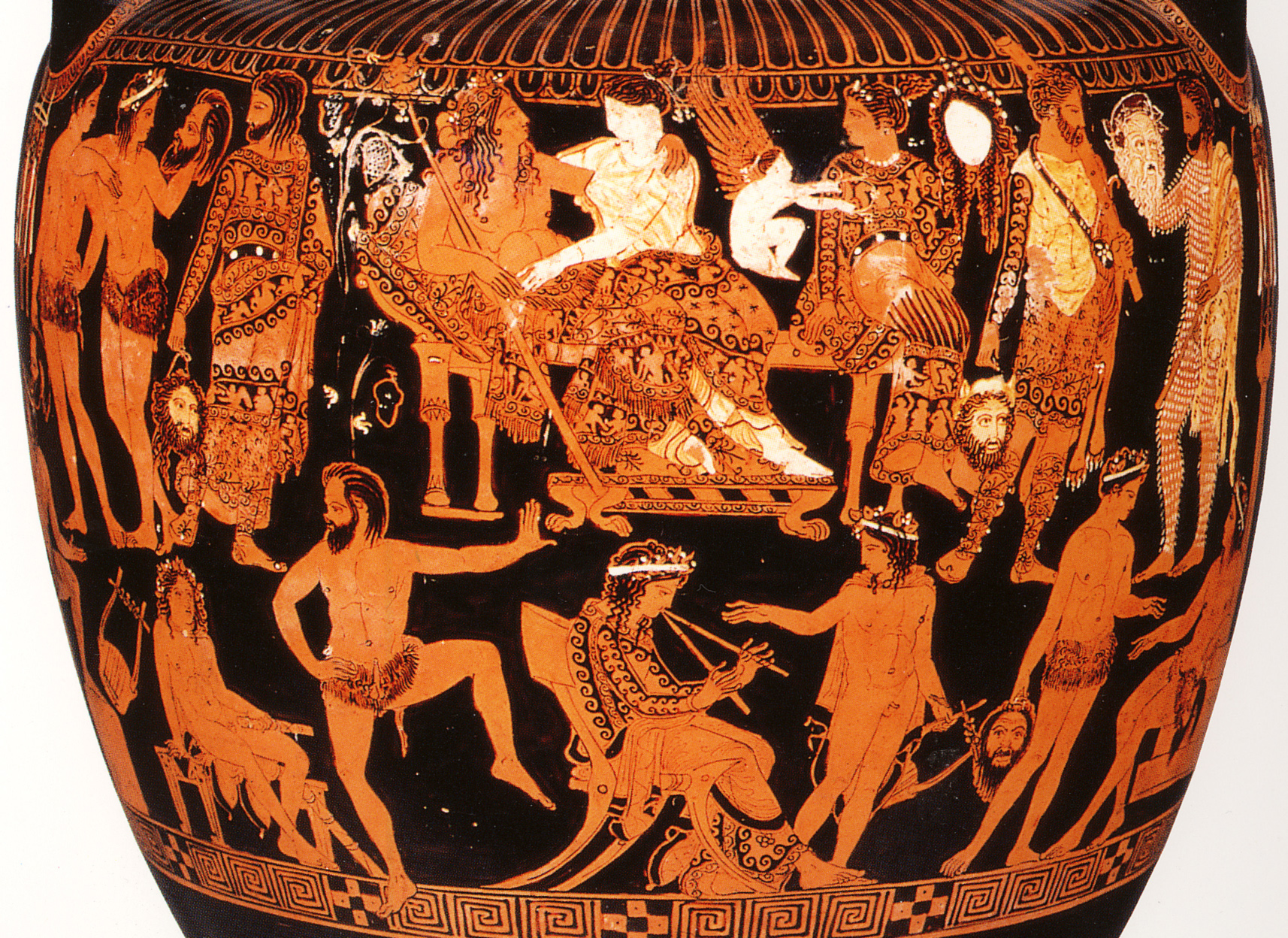
For the Dionysus section, theatre facilitator Olivia Gillman in the UK used the Dionysus animation as the basis for a drama class. Students acted out the vase scene and created improvisations around ancient theatre.

Chester Mbangchia, teaching in Cameroon, created a lesson that introduces Dionysus, god of drama, wine, and transformation. All drama students must learn about the origins of ancient theatre. This chapter and its videos provide an effective introduction to drama and how it developed.
Above, the Dionysus chapter with its vase (National Museum in Warsaw EXC243) and the storyboard that was used to plan its animation.

Libation
For the Libation chapter, Sonya Nevin created a lesson plan that teaches about the iconography of ancient gods and how they can be recognised – useful for ancient religion and for art history. This accompanies the Libation animation, which shows the gods Zeus and Athena performing a libation sacrifice.

Michael Stierstorfer of the Gymnasium Schäftlarn, near Munich in Germany, used the same animation in a lesson about sacrifice in ancient Greece: what was done, how, and what it all meant. Animal sacrifice is often a more familiar concept to learners than libation, so a lesson that explores what libation is in the context of sacrifice can be really useful. Dr Stiefstorfer’s lesson also features a Latin language element – that can be included or skipped over according to what best suits the class working with it.

Above, Libation, a visual resource for demonstrating this form of ancient liquid sacrifice. Teaching Ancient Greece has two lessons connected to this vase and its animation and you'll find its PowerPoint on the Libation page of the Panoply site.

Iris
Dean Nevin, a teacher in Switzerland, brings us a writing challenge for younger learners. This session would also work well as a modern foreign language exercise. The class learn about the messenger god Iris and then write a message for her to carry.

Terri Kay Brown of Westlake Girls School in New Zealand (Aotearoa) created an introduction to anthropology. This is a chance to compare different cultures’ myths about the rainbow and to consider what is indicated by the differences and similarities between them.

Iris features in the Iliad more than you might expect. This chapter includes an info page featuring some passages in which she appears and a list of all her appearances. For study of the Trojan War, this can be an effective way to think about the relations between gods and mortals.
Above, a beautifully decorated Iris, by Temperance in Ireland, with the Iris vase (National Museum in Warsaw 142289).

Heracles
Jessica Otto, then in Germany, now in St. Catherine's British School in Athens Greece, uses the Heracles animation to show how stories can be represented and decoded through visual clues.

Barbara Strycharczyk of Strumienie High School in Józefów, Poland, established a project for pupils in multiple years of the school who worked collaboratively to research the hero Heracles: they studied his adventures, they made maps, they wrote newspaper reports, they made mathematical models, they drew pictures, and it all came together in a multi-year group exhibition.
Above, Heracles, club in hand, with the defeated Erymanthian Boar, by a pupil at Strumienie High School, Poland.

Museums
Museum educator Jennie Thornber, at the Fitzwilliam Museum in Cambridge, UK, created a session for exploring museums in person or online and taking on the role of a curator. This is a great lesson for learning to use material sources as evidence, understanding what curators do, and building confidence about using museums and their websites. A PowerPoint on the Panoply site is one of several providing extra support for these activities.

Louise Maguire of Blackrock College, Dublin and the Classical Association of Ireland Teachers sets a more detailed museum challenge. In the role of curators, students plan exhibtions, considering extra factors such as audience, marketing and communication, budget, and accessibility - a creative challenge that drops students virtually into the world of work asking them to consider others and to think about what they have learned and how they can communicate their knowledge effectively.

If all these animation-orientated activities make you feel like having a go at making your own stop-motion animation, look no further. Christina dePian, a museum educator based in Greece ( https://www.kinoumeno.gr ), provides a detailed and accessible guide to making stop motions. There is information about stop-motion equipment and a lesson plan that goes through the steps of making an animation with a class (or making one yourself). Accompanied by a set of animation resources, this guidance makes it easy for anyone from 5 to 105 to try animation and create their own version of antiquity.
Above, with the stop-motion figures and guide, anyone can give ancient world stop-motion a go.

Teaching Ancient Greece is an action-packed set of resources to make learning enjoyable, challenging, and memorable.

All the animations and other videos can be seen online at https://panoply.org.uk

You can download your free copy of Teaching Ancient Greece here and hard copies are available here.

Thanks again to everyone who made it possible through contributions, editing, reviewing, artwork and more, and to the European Research Council for generously funding it.
We hope you enjoy exploring the ancient world with it!

Above, l-r at the University of Warsaw, Elżbieta Olechowska, Katarzyna Marciniak, Sonya Nevin, and Steve K. Simons. Below, Sappho Fragment 44. The Marriage of Hector and Andromache

Tuesday, 21 March 2023

Classical Mythology and Children's Literature... An Alphabetical Odyssey

Spring is here! And with it – a free book! The latest publication from Our Mythical Childhood is Classical Mythology and Children's Literature... An Alphabetical Odyssey, by Elizabeth Hale and Miriam Riverlea. An exciting bonus – it’s illustrated by Panoply’s very own Steve Simons!

Alphabetical Odyssey takes you on a journey through the oceans of children’s books inspired by ancient Greek and Roman mythology. The 26 chapters discuss elements important in literature for young readers, providing insights into how mythical adaptations, retellings, and allusions connect with aspects of childhood and adolescence. The chapters are arranged alphabetically, such as E is for Emotions, J is for Journeys, N is for Nature, and O is for the Olympians, and each comes with their own illustration.

You can download a free copy here. Share the download link as much as you like. The book will have a special appeal to anyone interested in classical mythology, classical reception, and/or young people’s literature.

You can find other free downloads from the Our Mythical Childhood series, and hard copies of the books available for sale here

All too soon, they will be joined by Teaching Ancient Greece: Lesson Plans, Vase Animations, and Resources, a book based around Panoply’s Our Mythical Childhood animations featuring 15 lesson plans by teachers from all over the world and all sorts of bonus resources to go with them. We’ve been working on that for a good while now and can’t wait for you to see it. Watch this space for news. If you’ve managed to miss the OMC animations and documentaries, take a look here: https://www.panoply.org.uk/our-mythical-childhood

Above, entrance to The Allard Pierson Museum of Antiquities in Amsterdam

We’ve had a busy start to the year. January saw us at the Allard Pierson Museum at the University of Amsterdam in the Netherlands. Panoply’s Sonya Nevin was there to present at the Ancient Vases in Modern Showcases conference, organised by Laurien de Gelder and Vladimir Stissi. Kate Cooper of the Royal Ontario Museum gave a stonking key note speech, outlining all sorts of factors that must be considered when planning a vase gallery or exhibition. Consider even the difference between arranging vases chronologically, arranging them by type of vase, displaying artefacts according to their decoration to express themes such as Trojan War, Sport, or Warfare, or the effect of grouping similar objects from different cultures. These are all solid options, yet they create a different experience for the museum visitor and a different impression of the objects and their meanings.

We also heard from Jill Hilditch, who has tackled the display of prehistoric ceramics and objects with unknown functions. You may recall the interview that Dr Hilditch did for Panoply a little while back discussing her research project, Tracing the Potter’s Wheel. Sally Waite and Olivia Turner presented a public programme, You Echo Through Time , which they ran at the at the Great North Museum in the UK, helping modern women explore their own experiences through an artefact-based search for the voices of ancient women. David Saunders of the J.Paul Getty outlined the approach that will be taken in a forthcoming exhibition, placing Mayan, Moche, and ancient Greek ceramics beside one another to prompt reflections and comparisons. One to look out for.
Above, David Saunders outlines the ideas involved in the Getty's forthcmoing exhibition of Mayan, Moche, and Greek Pottery

Sonya’s presentation outlined the way in which vase animations provide a bridge between the museum and the wider community – creating opportunities for people to see artefacts outside the museum space – seeing them in a new form in the classroom, in theatres and cinemas, projected onto walls, on tablets in parks – all sorts of spaces - and offering a prompt for further creative engagements with the artefacts, be it drawing, pottery-making, poetry, storytelling and more besides. Enjoying an ancient artefact does not have to mean simply looking at it; seeing can be only the beginning.
Above, Vases beyond the museum: a school event in Poland sees teens watching Panoply vase animations in a theatre before giving their own research presentations and making their own ceramic designs.

Sonya recently gave a different sort of talk closer to home in Cambridge, at the Digital Education Futures Initiative ( https://www.deficambridge.org/). This initiative, developed at Hughes’ Hall, Cambridge, creates opportunities for developing new models of education and new research priorities arising due to the growing prevalence of digital technology. Recent talks have explored digital tech’s ability to harness collective intelligence; Camtree, also based at Hughes’ Hall, which creates opportunities for teachers to conduct and share research and improve learning outcomes; and Sonya’s presentation on how digital technology has enabled new insights into the study of ceramics and ancient iconography.

We will have more news for you soon. Coming up are a new About Dionysus documentary to complement our Dionysus animation; news on an exhibition in the US that we've contributed to; and insights into the Islanders exhibition, which is on now at the Fitzwilliam Museum in Cambridge.

Sunday, 25 April 2021

New Animation Extravaganza!


Hooray for new animations! We are delighted that we have new animations for you – all the videos made for the Our Mythical Childhood project are now online! You can find them on their own page on the Panoply website: http://www.panoply.org.uk/omc.html . There are five new vase animations: Sappho 44, Heracles and the Erymanthian Boar, Dionysus, Libation, and Iris- Rainbow Goddess. There are two mini-documentaries: About Sappho 44 and About Heracles, and a brand new recording of Sappho 44 sung in ancient Greek by Aliki Markantonatou according to the score written by Prof. Armand D'Angour – a version of the tune that the poem would have been sung to in antiquity. You will also fine a wealth of bonus material – information about the vases and the animations, downloadable information and activity sheets, and PowerPoint presentations to help integrate the animations into lessons and lectures. We hope you have fun exploring these resrouces and trying them out.

Above, Panoply's Sonya Nevin concentrating hard during the online launch of the Our Mythical Childhood animations and Panoply's new partnership with the Cambridge Schools Classics Project.

Many thanks to everyone who attended or spoke at the launch event for the videos. In addition to introductions to the videos, we heard from Our Mythical Childhood Principal Investigator Professor Katarzyna Marciniak, from Lisa Hay, Olivia Gillmann and Rob Hancock-Jones on their pioneering teaching with Panoply vase animations, and from Head of CSCP Caroline Bristow about where the OMC animations, videos and other resources can fit into the UK and Irish curriculums. It was great to see lots of positivity and creative teaching practice.

This event also marked the launch of our new partnership with the Cambridge Schools Classics Project - a long-standing organisation at the University of Cambridge committed to supporting classics teaching. In due course, CSCP will be hosting our website - it will remain at the same www.panoply.org.uk address but will get a revamp and some extra materials. More on that as it happens. All the Our Mythical Childhood materials will soon be available on the Our Mythical Childhood website too – where you'll also find links to the other supercool projects under the OMC banner.

As you've reached the Panoply blog, I'm going to take the opportunity to point out some of its highlights. You can explore simply by scrolling through or using the Labels on the right of the page, but to jump straight in, you might fancy:

Ancient pottery meets ancient theatre, an interview with Dr Rosie Wyles

On Greek Myth Comix, by classics teacher and comic-maker L.E. Jenkinson-Brown

Symposiums, an interview with vase king Prof. Sir John Boardman

On Ancient music, an interview with Prof. Conrad Steinmann, who provided music for the OMC animations Dionysus, Libation and Iris.

You'll also find discussions of events, vases, and other art related to classical culture, such as:
Black and White Andromeda - a discussion of the representation of the Princess of Ethiopia, from ancient vases to modern young people's literature.
Happy Birthday Panoply - a potted history of our adventures with vase animations.

The Force Awakens Greek Vase Scenes - a look at Star Wars-Greek Vase fan mash-ups.

A big thank-you to everyone who has contributed to creating the Our Mythical Childhood videos. We hope you have a great time using them.

Thursday, 11 March 2021

New Talks, New Animations, New Books


Good news vase fans! Lots of interesting things coming up. It is finally the time to launch online the new animations that we've been making for the ERC-funded project Our Mythical Childhood... The Reception of Classical Antiquity in Children’s and Young Adults’ Culture in Response to Regional and Global Challenges. They'll be launched at a free online event on Saturday 24th April. This event will be an interesting and enjoyable affair. Along with the animations there'll be short talks about them, presentations from teachers who have been trialling them in the classroom along with their bonus resources, a performance of ancient music, and a chance to see the short 'About' videos that accompany the animations. Registrations can be made here: https://www.teaching.cambridgescp.com/animating-ancient-world. Pop back here soon (or keep your eye on our FB page) for more info on the schedule.

You might notice that the booking page is a University of Cambridge address – that's because (*drumroll*) the Panoply Vase Animation Project is going into partnership with the university's Cambridge Schools Classics Project (CSCP: https://www.cambridgescp.com/). They've been supporting classics teachers for many years and we're pleased that this partnership will help us to help teachers more than ever. Our website will be migrating to CSCP (still at the same web address tho), so look forward to a new layout and cool new materials. In anticipation, here's the Iris animation, which got a forward release:


There will be an even earlier opportunity to hear Panoply's Dr Sonya Nevin talking about 'Beauty and Heroism' in the animations. Sonya will be giving a talk at 4pm GMT Wednesday 17th March as part of the University of Reading's Heroic Beauty: Beautiful Heroism series. The link to the talk and info about other talks in the series can be found here
.
In other good news, Sonya's book, Military Leaders and Sacred Space in Classical Greek Warfare is coming out in paperback after going down well in hardback. It's published by Bloomsbury and available at: https://www.bloomsbury.com/uk/military-leaders-and-sacred-space-in-classical-greek-warfare-9781350247130/. Take a look! This coincides nicely with Sonya completing her second book - a deep dive into the Battle of Marathon - why it happened, what happened, and how it influenced society in the weeks, years, and then centuries after the battle. More on that as things unfold, and a high-five to everyone at Bloomsbury who have been so supportive during the writing of the book.

Hope to see you at the talk on Wednesday and for good times in April.

Friday, 23 October 2020

Black History Month – Black and White Andromeda

This month I had the opportunity to contribute to an Our Mythical Childhood discussion of black history and classical reception in young people's culture, organised by the University of Roehampton's Professor Susan Deacy. It was an easy choice for me to decide what to focus on – Olympians – a series of graphic novels by New York artist George O'Connor – a series which has been one of the highlights of my work on the Our Mythical Childhood database of antiquity in modern young people's culture. And within OlympiansAndromeda!
Andromeda is a mythical Ethiopian princess, making her one of the explicitly non-Greek named characters of Greek mythology. She's best known for being offered up as a sacrifice to the sea monster, Ketus, and being rescued by Perseus. Andromeda features quite frequently in modern children's literature, but it is noticeable how often she is depicted as being white. In this post we'll look at the dual traditions of black and white Andromeda and at George O'Connor's refreshing depiction of her.
Above, one of many white Andromeda's in modern children's literature - this one from Usborne's Sticker Greek Myths, fair-skinned and red headed.

Above, Tom Kindley's Heroes of the Night Sky is hugely creative although nonetheless Andromeda is depicted as very fair-skinned and blonde.

Depicting Andromeda as a white woman can be seen as a missed opportunity to feature a diversity of skin tones and ethnicities in the representation of ancient Greek culture. Modern illustrators are not alone in doing this however; it's part of a long tradition of white Andromedas, largely begun by ancient Greek vase painters. In this example below, we can see that the vase painter has prioritised the convention of depicting women using white slip, even when applying it to Andromeda, princess of Ethiopia. The ancient Greeks' concept of Ethiopia does not exactly correspond to the modern nation state of that name. They imagined Ethiopians living at the far regions of the earth in both Africa and Asia – where the sun sets and rises. Nonetheless, they did conceive of the Ethiopians as dark skinned (and extremely attractive) - even the name 'Aethiops' implies dark skin.
Above, a 6th century BCE Corinthian depiction of Andromeda (far right) rescued by Perseus (centre), with Andromeda's skin picked out in white slip as it would be for other women in that period. Vase now in the Berlin Altes Museum, F 1652

Ancient Greek vase painters were more than able to depict black Africans when they wanted to. Numerous vases include depictions of black Africans. Sometimes they're shown doing something; sometimes the vase maker focuses on the person's head, drawing out contrasts in appearance. Some of these approach caricature and are not very nice, sometimes they're more respectfully done and rather beautiful.
Above, an Athenian kantharos, c.500BCE, Boston Museum of Fine Arts 98.926. This form of cup with two heads is known as 'janiform', here two women.
Above, an Athenian jug featuring the head of a male African youth, 4th century, Metropolitan Museum
Above, an Athenian pelike featuring a black African youth leading a camel, executed in red figure. Vase in the St Petersburg Hermitage.

Despite this ability to depict black Africans, Andromeda is not the only Ethiopian who Greek artists seem to have avoided depicting with that appearance. Memnon, King of Ethiopia, who fought at Troy is typically depicted as looking like the other lighter-skinned heroes, or his face is avoided altogether. The master painter Exekias depicts him on this vase with his helmet obscuring his face, standing between two African servants.
Above, a black figure amphora by Exekias, helmeted Memnon with black African servants, British Museum 1849,0518.10, © The Trustees of the British Museum

We can also see that even once black figure went out of style, and with it the use of white slip to depict women, Andromeda is not represented as a black woman although she is dressed in Asian trousers:
Above, an Athenian red-figure hydria (shoulder section) c.440BCE, preparations to sacrifice Andromeda, who is sporting Asian clothing. British Museum 1843,1103.24 © The Trustees of the British Museum.
Above, an Athenian red figure pelike by the Niobid Painter, c.440BCE. Andromeda offered for sacrifice, clothed in Asian trousers, accompanied by Africans depicted in black slip with white slip clothing. Boston Museum of Fine Arts, 63.2663.

Vase art and the art of mosaic makers, painters, and writers all influenced how people thought about Andromeda. By the time we reach the 1st century CE, the Roman poet Ovid was referring to Andromeda's white 'marble statue' body (Metamorphoses, 4.676). Heliodorus in the 3rd century CE went even further – the entire plot of his novel hinges on the Ethiopian princess being unexpectedly white. Heliodorus' Aethiopica and Ovid's Met were to have a huge influence on Renaissance painters and their vision of white Andromeda shaped later traditions around the princess. These are the origin of the white Andromedas in modern children's literature.
Above, one of many white Andromeda's, this one by Volpato after an earlier painting by Polidoro Caravaggio (c.1497-c.1543). As is frequently the case in images of this subject, Andromeda's white body is contrasted with the dark background of the rock.
Above, Edward Burne-Jones in the 19th century followed the same tradition, making much of the contrast of light and dark in his Perseus Series. Southampton City Art Gallery.

This is not the only tradition available to follow. Traditions around black Andromeda are however a bit of a mixed bag. In antiquity, we find a writer discussing black Andromeda and that writer is.... Ovid! The writer who contributed to traditions of white Andromeda also wrote about her elsewhere as a beautiful black woman. In Heroines and The Art of Love she is explicitly said to be dark skinned. This was not always taken up in a positive light, however. The Christian Fathers, early writers on Christian theology and philosophy, followed this tradition but used it to establish a connection between Andromeda's dark skin and human sinfulness. Dark Andromeda is human sin; fair Perseus is the symbol of Christ coming to the rescue with salvation. So far, so racist. Some Renaissance artists were also aware of this tradition, yet they didn't adopt its racist implications and instead they depicted a black Andromeda without the symbolic baggage of the Church Fathers. They were, however, inclined to hark back to the early idea of dark skinned Andromeda being Asian rather than African. We can see this not through the Persian clothing that we saw from Greek vase painters (Renaissance artists prefer a nude); we see it in her conspicuously long, straight hair.
Above, A dark skinned Andromeda, contrasted against the pale rocks, by Abraham van Diepenbeek, 1655.

This look at the background provides a context for thinking about the depiction of Andromeda in O'Connor's Olympians. She features most in the second volume, Athena - Grey-Eyed Goddess. When we first see Andromeda, she's chained to the rocks with the monster approaching. She's a beautiful dark skinned black woman, with her curly hair cropped short and a white dress on – the colour Ovid says that she preferred to wear because the colour looks good against her skin. She is frightened then, out of the corner of her well-lashed eye, she spots Perseus flying in to the rescue. The sea monster is turned to stone, and from just behind Andromeda we see Perseus politely introduce himself to her. Then we get the close-up of her endearing radiant smile, accompanied by a flash of gold from her earing. This is a positive depiction of her as a beautiful black African woman. The framing of the myth is also very positive. The narrator notes that while Perseus had a lot of help to carry out the Medusa mission, his decision to help Andromeda was his own choice and it proved his genuine heroism. We get an update that they fell in love, married, and moved to his homeland. She's not an automatic prize; it's a love match.
Above, the first glimpse of Andromeda in George O'Connor's 'Athena', 2010.

Above, scenes of Andromeda's rescue in George O'Connor's 'Athena', 2010.

Andromeda also features in O'Connor's Hera - The Goddess and Her Glory, the third installment of the Olympians series. Hera focuses largely on the Labours of Heracles. In discussing Heracles' origins, the narrator notes that Heracles' mother, Alcmene, was the granddaughter of Perseus and Andromeda, who are depicted at the famous rocky shore. While this is mythologically true, it's a connection within Heracles' background that is very rarely drawn attention to. You could read an awful lot about Heracles without finding reference to the Ethiopian element of his ancestry. This aspect of Heracles' background is also framed very positively in the text. There is explicit reference to Perseus and Andromeda founding many of the great cities of ancient Greece and forming 'the mightiest royal family in antiquity'. The greatest hero owes plenty of his greatness to his fantastic great-grandmother, Andromeda. Nor is Heracles white-washed in the Olympians series; it’s a series that features a wide range of skin tones and Heracles is amongst the darker toned heroes, presumably in reference to his part-Ethiopian heritage.

Above, Heracles' lineage includes his mighty great-grandmother, Andromeda.

This whizz through art history has been a reminder that the ways in which we think about ancient figures are influenced by long and complex historical processes. All artists have agency, however, and choices get made. George O'Connor's Olympians series gives us a positive interpretation of Andromeda which celebrates her legendary beauty, her blackness, and her legacy within Greek mythology. When we think about diversifying the Classics, whether in the classroom or in children's publishing, one simple yet powerful step is to honour the Ethiopians who have always been part of it.


Some references:
Elizabeth McGrath, 'The Black Andromeda', Journal of the Warburg and Courtauld Institutes, Vol. 55 (1992), pp. 1-18.
George O'Connor, Athena, FirstSecond, 2010.
George O'Connor, Hera, FirstSecond, 2011.

Monday, 4 May 2020

New Animation! Iris - Rainbow Goddess

Animation time vase fans! We're delighted to share the first of five cracking animations made as part of the Our Mythical Childhood project . Below you'll find some info on Iris and on how the animation was made, but first, buckle-up for Iris – Rainbow Goddess!


Iris is a messenger goddess. She carries messages from one god to another, especially messages from Zeus and Hera. She has wings so that she can fly fast and far. When she flies, she leaves rainbows in her wake, streaking across the sky! That's where rainbows come from. Awesome!

The ancient Greeks were always on the look-out for unusual natural phenomena – they could be a sign sent by a god. In sunny Greece, rainbows are even more unusual than they are in rainy northern Europe. Iris was often called 'storm-footed' , because storms came with her as well as rainbows. As rainbows are unusual and linked to the coming of rain and storms, ancient Greeks thought that they could even be a sign of war approaching (e.g.Homer, Iliad, 17.547 ). The poet Hesiod said that Iris was a sister of the terrible Harpies (Theogony, 265)! Still, she had a job to do and you don't hang around when you're carrying a message for Zeus or Hera! In an age when we can send messages near and far so easily, it's good to be reminded how amazing the idea of super-fast messages would be.

Above, the pot that Iris – Rainbow Goddess was made from - a hydria in the National Museum in Warsaw, in Poland (number 142289).

The pot that we made the animation from is an Athenian hydria, or water carrier, from c.450BCE. Iris is shown as if she has just landed, or is just about to take off - her knees are slightly bent, her wings up. In her hand she carries her herald's staff – the sign that she is a messenger. Her wings have been positioned very cleverly so that they fit onto the shoulder of the vase.

Above, Panoply animator Steve gets a good look at Iris at the National Museum in Warsaw.

You may have noticed – the animation also features a first for us – it's a 3D vase! We measured the dimensions of the vase carefully, then re-created it in 3D. Once we had the digital vase, the animation - made from the original vase's decoration the way all our vase animations are made - was added as a layer onto its surface. The cracks that the vase has suffered and had repaired over the years were also added back onto the vase as a layer.

Above, the vase began life as a pillar.

Above, the pillar was manipulated to match the vase dimensions. A room was created to house it.
Above, Iris is invited to the vase! Note the rainbow in her eye to draw out the Iris-eye iris connection that exists in English (and some other languages) - the iris is the coloured part of your eye which controls how much light gets in.

For the soundscape of the animation, we hear rain and the beginning of a storm – perfect conditions for Iris. With it you hear the sound of aulos pipes, played by ancient music specialist, Prof. Conrad Steinmann.

In the future, Iris will have her own page on our website along with the other Our Mythical Childhood animations. We're in the process of making some changes to the website, so for now, if you'd like to download some fun activities to do with Iris, please head on over to her page on the Our Mythical Childhood website: http://omc.obta.al.uw.edu.pl/iris

Create your own Iris with the activity sheets on the Our Mythical Childhood page.