Showing posts with label Our Mythical Childhood. Show all posts

Thursday, 7 November 2024

New Book: Teaching Ancient Greece

We are pleased to share the release of Teaching Ancient Greece: Lesson Plans, Animations and Resources! This Open Access volume (that is, free to download) has been published by the University of Warsaw Press. It’s bursting with ideas from the Panoply Vase Animation Project and an international team of fantastic contributors to whom we’re very grateful.

1) What’s it all about?
In short, Teaching Ancient Greece is a set of resources and lesson plans to complement the vases animations and documentaries that we made for the project Our Mythical Childhood. The Reception of Classical Antiquity in Children’s and Young Adults’ Culture in Response to Regional and Global Challenges. The resources and lesson plans are ready to use and can of course be adapted for the particular circumstances of each learning environment. The videos are:
Iris. Rainbow Goddess.
About Iris - Rainbow Goddess (on the Iris page).
Heracles and the Erymanthian Boar.
About Heracles and the Erymanthian Boar (on the Heracles and the Erymanthian Boar page).
Sappho Fragment 44. The Marriage of Hector and Andromache.
About Sappho 44 and Sappho 44 Set to Music (both on the Sappho page).
Libation.
Dionysus.
and
About Dionysus:


2) What topics does it cover?
Pottery gives us insight into all sort of areas of life, so this collection connects with many topics. As well as pottery and art history, there's material on ancient religion and sacrifice, music, museums, curators and collections history, poetry and other forms of creative writing, the origins of drama, relationships and marriage, hunting, war, Latin and modern foreign languages, anthropology, and more.
Above, Sonya Nevin of the University of Warsaw and the Panoply Vase Animation Project with Teaching Ancient Greece in the National Museum in Warsaw - which houses the vases that the volume is based on.

2) What activity sheets are there in Teaching Ancient Greece?
You’ll find info and activity sheets covering:
• The Greek alphabet.
• A chronology of Greek pottery.
• A guide to Greek pottery shapes, illustrated by Steve K Simons.
• A guide to gods and their symbols.
• An activity sheet for matching gods to their symbols.
• Various blank vase shapes for creating new designs or copying existing designs to improve close visual reading and attention to detail.
• Line drawings of existing vase designs to colour, for younger learners and those who enjoy the relaxation of colouring; these can be made into feisty gifs.
• There’s an activity sheet for creating a scene from Sappho’s poetry.
• The musical score to Sappho 44, determined by Armand D’Angour of Jesus College, Oxford. Play your own version of it.
• A blank storyboard for planning new vase animations, as well as example storyboards which were used to plan Panoply’s Our Mythical Childhood animations.
• A huge set of stop-motion figures by Panoply’s Steve K Simons to make animations with.

• As well as activity sheets, each animation comes with a PowerPoint about the vase and its subject and there are bonus PowerPoints about the work of museum curators and about the Greek Gods. All these can be downloaded for free from the Panoply site.
Above, part of Teaching Ancient Greece's info page on ancient Greek vase shapes.

3) What are the lesson plans about and who designed them?
Created by experienced educators, each lesson plan contains an introduction, a lesson including one of the vases and its animation, and an exciting activity to extend the learning experience. The target audience is secondary school pupils, but the lessons can all be adapted for older or younger groups. The book takes you through lesson plans introducing pottery, through topics connected to the five animated vases, onto museum themed sessions, and then into stop-motion. Let’s look at what’s in there:

Pottery
In the chapter Understanding Vases, Warsaw/Panoply’s Sonya Nevin offers an intro to the uses, styles, and shapes of ancient Greek pottery, with lessons to embed that information, including activities with clay.
Above, painted pottery sherds created by trainee teachers at the University of Cambridge Faculty of Education practicing a pottery lesson in Teaching Ancient Greece. Drawing vase scenes, especially on clay, is a great way to improve attention to visual detail and to clarify the difference between red and black figure techniques. Creating new designs synthesises what has been learned about ancient culture.

Sappho
The Sappho chapter features Rob Hancock-Jones of Townley Grammar School in the UK. He used the Sappho animation to develop a lesson on marriage and relationships in ancient Greece. This is a particularly good fit for the Love and Relationships part of OCR’s Classical Civ. A-Level.

Igor Cardoso of Colégio Santa Amélia in Brazil created a lesson about Sappho which encouraged young people to think about facing difficult situations and emotional resilience. His students wrote short stories and poetry about Andromache and the Trojan War.

Ancient music specialist Aliki Markantonatou in Greece created a lesson that is a step-by-step walk through composing lyric poetry. This complements her unique recording of Sappho 44, which you can hear along with the Sappho animation and documentary.
Above, the Sappho chapter with the Sappho vase it was based on (National Museum in Warsaw 142333).

Dionysus
For the Dionysus section, theatre facilitator Olivia Gillman in the UK used the Dionysus animation as the basis for a drama class. Students acted out the vase scene and created improvisations around ancient theatre.

Chester Mbangchia, teaching in Cameroon, created a lesson that introduces Dionysus, god of drama, wine, and transformation. All drama students must learn about the origins of ancient theatre. This chapter and its videos provide an effective introduction to drama and how it developed.
Above, the Dionysus chapter with its vase (National Museum in Warsaw EXC243) and the storyboard that was used to plan its animation.

Libation
For the Libation chapter, Sonya Nevin created a lesson plan that teaches about the iconography of ancient gods and how they can be recognised – useful for ancient religion and for art history. This accompanies the Libation animation, which shows the gods Zeus and Athena performing a libation sacrifice.

Michael Stierstorfer of the Gymnasium Schäftlarn, near Munich in Germany, used the same animation in a lesson about sacrifice in ancient Greece: what was done, how, and what it all meant. Animal sacrifice is often a more familiar concept to learners than libation, so a lesson that explores what libation is in the context of sacrifice can be really useful. Dr Stiefstorfer’s lesson also features a Latin language element – that can be included or skipped over according to what best suits the class working with it.

Above, Libation, a visual resource for demonstrating this form of ancient liquid sacrifice. Teaching Ancient Greece has two lessons connected to this vase and its animation and you'll find its PowerPoint on the Libation page of the Panoply site.

Iris
Dean Nevin, a teacher in Switzerland, brings us a writing challenge for younger learners. This session would also work well as a modern foreign language exercise. The class learn about the messenger god Iris and then write a message for her to carry.

Terri Kay Brown of Westlake Girls School in New Zealand (Aotearoa) created an introduction to anthropology. This is a chance to compare different cultures’ myths about the rainbow and to consider what is indicated by the differences and similarities between them.

Iris features in the Iliad more than you might expect. This chapter includes an info page featuring some passages in which she appears and a list of all her appearances. For study of the Trojan War, this can be an effective way to think about the relations between gods and mortals.
Above, a beautifully decorated Iris, by Temperance in Ireland, with the Iris vase (National Museum in Warsaw 142289).

Heracles
Jessica Otto, then in Germany, now in St. Catherine's British School in Athens Greece, uses the Heracles animation to show how stories can be represented and decoded through visual clues.

Barbara Strycharczyk of Strumienie High School in Józefów, Poland, established a project for pupils in multiple years of the school who worked collaboratively to research the hero Heracles: they studied his adventures, they made maps, they wrote newspaper reports, they made mathematical models, they drew pictures, and it all came together in a multi-year group exhibition.
Above, Heracles, club in hand, with the defeated Erymanthian Boar, by a pupil at Strumienie High School, Poland.

Museums
Museum educator Jennie Thornber, at the Fitzwilliam Museum in Cambridge, UK, created a session for exploring museums in person or online and taking on the role of a curator. This is a great lesson for learning to use material sources as evidence, understanding what curators do, and building confidence about using museums and their websites. A PowerPoint on the Panoply site is one of several providing extra support for these activities.

Louise Maguire of Blackrock College, Dublin and the Classical Association of Ireland Teachers sets a more detailed museum challenge. In the role of curators, students plan exhibtions, considering extra factors such as audience, marketing and communication, budget, and accessibility - a creative challenge that drops students virtually into the world of work asking them to consider others and to think about what they have learned and how they can communicate their knowledge effectively.

If all these animation-orientated activities make you feel like having a go at making your own stop-motion animation, look no further. Christina dePian, a museum educator based in Greece ( https://www.kinoumeno.gr ), provides a detailed and accessible guide to making stop motions. There is information about stop-motion equipment and a lesson plan that goes through the steps of making an animation with a class (or making one yourself). Accompanied by a set of animation resources, this guidance makes it easy for anyone from 5 to 105 to try animation and create their own version of antiquity.
Above, with the stop-motion figures and guide, anyone can give ancient world stop-motion a go.

Teaching Ancient Greece is an action-packed set of resources to make learning enjoyable, challenging, and memorable.

All the animations and other videos can be seen online at https://panoply.org.uk

You can download your free copy of Teaching Ancient Greece here and hard copies are available here.

Thanks again to everyone who made it possible through contributions, editing, reviewing, artwork and more, and to the European Research Council for generously funding it.
We hope you enjoy exploring the ancient world with it!

Above, l-r at the University of Warsaw, Elżbieta Olechowska, Katarzyna Marciniak, Sonya Nevin, and Steve K. Simons. Below, Sappho Fragment 44. The Marriage of Hector and Andromache

Friday, 8 December 2023

Autumn Animations: The Rattle, The Banquet, The Doctor’s Game, and ‘Teaching Ancient Greece’.

Time to reflect on a busy few months and bring you some animations, pictures and updates! Early Autumn saw us visiting the University of Fribourg in Switzerland, to release new animations for the Locus Ludi project (https://locusludi.ch/ ). Under the leadership of Veronique Dasen, Locus Ludi has been exploring play and games in classical antiquity. Results from the project were presented at a university open day, Explora 23. Panoply’s Sonya Nevin presented the Locus Ludi artefact animations. These animations have stretched us beyond vases to include wall-paintings and low-relief stone carvings. Perhaps you’ve seen Hide and Seek in Herculaneum, made from a fresco in the volcano-hit city. You will have had less chance to see the new vase animation, The Rattle, and its companion video, About the Rattle. You can see them here below and they now have their own page, with a bonus PowerPoint, on the main Panoply site. We’ll add a few other Locus Ludi animations in the New Year once their related resources have been finalised.


Above, The Rattle and About the Rattle made from a small jug now housed in the British Museum. For more on this topic, see https://www.panoply.org.uk/rattle .

Explora 2023 also saw members of the public playing Roman board games and there was a screening of the project’s documentary about a mercury-filled Roman dice that some cheeky Romans used for cheating at dice games.
Above, a Roman-style board-game prepared by Ulrich Schӓdler, played at the University of Fribourg’s Explora Open Day.
Above, Panoply’s Sonya Nevin presents the new artefact animations at Explora 23 at the University of Fribourg, Switzerland.
Above, Explora 23 was a public showcase of research from across the University of Fribourg.

Meanwhile back in the UK, a new exhibition was opening at the Ure Museum of Greek Archaeology at the University of Reading. Locus Ludi – Anyone Can Play! was inspired by Locus Ludi and included all sorts of aspects of play and games in antiquity. Panoply collaborated with the Ure Museum team to make an animated documentary for the exhibition about an ancient board game from the Roman collection at Colchester Castle. You can see The Doctor’s Game here (length 1.55 min):


Above, a case from Locus Ludi – Anyone Can Play! at the Ure Museum of Greek Archaeology, University of Reading. For an interactive version, visit the exhibition homepage

After a pit stop in Cambridge, we were off to Sicily. We travelled round this fabulous island and popped in to see Ludovico Portuese of the University of Messina. Ludovico leads the GALATEO project ( https://galateo.unime.it/), exploring etiquette in ancient Mesopotamia. You can read about his research and use of ceramics as evidence in this recent Panoply interview. Earlier in 2023, Panoply animated two artefacts for the GALATEO project, which can be seen online and irl in the Penn Museum in the USA:


Above, The Banquet, made as part of the GALATEO project from an Assyrian ivory plaque. For more on it, see: https://www.panoply.org.uk/banquet.


Above, Worshipping the Gods, made as part of the GALATEO project from a Mesopotamian stone stele. For more on it, see: https://www.panoply.org.uk/worshipping-gods

We visited some fabulous ancient sites in Sicily, saw plenty of great vases in the well-stocked museums, and caught a puppet-show – the traditional Sicilian artform which is an ancestor of vase animations.
Above, a beautiful depiction of Perseus by the Phiale Painter, white ground calyx krater in the Agrigento Archaeological Museum (inv. A67, Beazley 214231).
Above, puppets from the Puppet Museum at Syracuse; a show at their theatre is a must for animation fans

Autumn also saw us return to University College Dublin to talk about how things have developed at the Panoply Vase Animation Project since we began animating vases in the UCD School of Classics way back when.
Above, a poster for Sonya's talk at University College Dublin on the history of the Panoply vase animations.

Meanwhile, our old friend, Hoplites! Greeks at War has gone on display as part of the Hoplites exhibition at the Déri Museum in Hungary. Having the animation displayed amongst the warfare artefacts gave visitors a chance to see the equipment in action, making it clearer what it was for and how it worked.
Above, visitors to the Hoplite exhibition at Déri Museum in Hungary, where vase animation put helmets and other equipment in context.

Last, but not least, we are glad to report progress on a project we’re very excited about: Teaching Ancient Greece. Lesson Plans, Vase Animations, and Resources. Teaching Ancient Greece, edited by Panoply’s Sonya Nevin, is a book of resources for using the Our Mythical Childhood vase animations in teaching and learning. It’s nearing completion and will be out next year. While hard copies will be available to buy, we’re delighted that it will be available as an Open Access download, through its publisher, Warsaw University Press. It features contributions from teachers and other educators all over the world and is chock full of handy resources and bright ideas. Watch this space for more news. In the meantime, checkout the other Open Access publications in the Our Mythical Childhood series:

Susan Deacy, What Would Hercules Do? Lessons for Autistic Children Using Classical Myth (2023), featuring vase illustrations by Panoply's Steve K Simons.

Katarzyna Marciniak (ed.), Our Mythical Hope. The Ancient Myths as Medicine for the Hardships of Life in Children’s and Young Adults’ Culture (2021), essays on antiquity in modern young people's literature.

Lisa Maurice (ed.) Our Mythical Education. The Reception of Classical Myth Worldwide in Formal Education, 1900-2020 (2021), how classical myth fits into school curricula around the world.

Elizabeth Hale and Miriam Riverlea, Classical Mythology and Children's Literature... An Alphabetical Odyssey (2022), a guide to the use of classical myth in modern children's lit, featuring an a-z of chapter illustrations by Panoply's Steve K Simons.

Above, Teaching Ancient Greece. Lesson Plans, Vase Animations, and Resources, will join these Open Access Our Mythical Childhood publications in 2024. Download your free copies from the Warsaw University Press site: https://www.wuw.pl/tra-eng-58207-Our-Mythical-Childhood.html

Thanks for all your support over the year. We wish you all the best for your new adventures in 2024!

Tuesday, 21 March 2023

Classical Mythology and Children's Literature... An Alphabetical Odyssey

Spring is here! And with it – a free book! The latest publication from Our Mythical Childhood is Classical Mythology and Children's Literature... An Alphabetical Odyssey, by Elizabeth Hale and Miriam Riverlea. An exciting bonus – it’s illustrated by Panoply’s very own Steve Simons!

Alphabetical Odyssey takes you on a journey through the oceans of children’s books inspired by ancient Greek and Roman mythology. The 26 chapters discuss elements important in literature for young readers, providing insights into how mythical adaptations, retellings, and allusions connect with aspects of childhood and adolescence. The chapters are arranged alphabetically, such as E is for Emotions, J is for Journeys, N is for Nature, and O is for the Olympians, and each comes with their own illustration.

You can download a free copy here. Share the download link as much as you like. The book will have a special appeal to anyone interested in classical mythology, classical reception, and/or young people’s literature.

You can find other free downloads from the Our Mythical Childhood series, and hard copies of the books available for sale here

All too soon, they will be joined by Teaching Ancient Greece: Lesson Plans, Vase Animations, and Resources, a book based around Panoply’s Our Mythical Childhood animations featuring 15 lesson plans by teachers from all over the world and all sorts of bonus resources to go with them. We’ve been working on that for a good while now and can’t wait for you to see it. Watch this space for news. If you’ve managed to miss the OMC animations and documentaries, take a look here: https://www.panoply.org.uk/our-mythical-childhood

Above, entrance to The Allard Pierson Museum of Antiquities in Amsterdam

We’ve had a busy start to the year. January saw us at the Allard Pierson Museum at the University of Amsterdam in the Netherlands. Panoply’s Sonya Nevin was there to present at the Ancient Vases in Modern Showcases conference, organised by Laurien de Gelder and Vladimir Stissi. Kate Cooper of the Royal Ontario Museum gave a stonking key note speech, outlining all sorts of factors that must be considered when planning a vase gallery or exhibition. Consider even the difference between arranging vases chronologically, arranging them by type of vase, displaying artefacts according to their decoration to express themes such as Trojan War, Sport, or Warfare, or the effect of grouping similar objects from different cultures. These are all solid options, yet they create a different experience for the museum visitor and a different impression of the objects and their meanings.

We also heard from Jill Hilditch, who has tackled the display of prehistoric ceramics and objects with unknown functions. You may recall the interview that Dr Hilditch did for Panoply a little while back discussing her research project, Tracing the Potter’s Wheel. Sally Waite and Olivia Turner presented a public programme, You Echo Through Time , which they ran at the at the Great North Museum in the UK, helping modern women explore their own experiences through an artefact-based search for the voices of ancient women. David Saunders of the J.Paul Getty outlined the approach that will be taken in a forthcoming exhibition, placing Mayan, Moche, and ancient Greek ceramics beside one another to prompt reflections and comparisons. One to look out for.
Above, David Saunders outlines the ideas involved in the Getty's forthcmoing exhibition of Mayan, Moche, and Greek Pottery

Sonya’s presentation outlined the way in which vase animations provide a bridge between the museum and the wider community – creating opportunities for people to see artefacts outside the museum space – seeing them in a new form in the classroom, in theatres and cinemas, projected onto walls, on tablets in parks – all sorts of spaces - and offering a prompt for further creative engagements with the artefacts, be it drawing, pottery-making, poetry, storytelling and more besides. Enjoying an ancient artefact does not have to mean simply looking at it; seeing can be only the beginning.
Above, Vases beyond the museum: a school event in Poland sees teens watching Panoply vase animations in a theatre before giving their own research presentations and making their own ceramic designs.

Sonya recently gave a different sort of talk closer to home in Cambridge, at the Digital Education Futures Initiative ( https://www.deficambridge.org/). This initiative, developed at Hughes’ Hall, Cambridge, creates opportunities for developing new models of education and new research priorities arising due to the growing prevalence of digital technology. Recent talks have explored digital tech’s ability to harness collective intelligence; Camtree, also based at Hughes’ Hall, which creates opportunities for teachers to conduct and share research and improve learning outcomes; and Sonya’s presentation on how digital technology has enabled new insights into the study of ceramics and ancient iconography.

We will have more news for you soon. Coming up are a new About Dionysus documentary to complement our Dionysus animation; news on an exhibition in the US that we've contributed to; and insights into the Islanders exhibition, which is on now at the Fitzwilliam Museum in Cambridge.

Tuesday, 20 September 2022

Iris – Rainbow Goddess, and Munich - Classical Playground

We are delighted to share our new documentary with you: About Iris – Rainbow Goddess. This mini doc is a companion piece for the Iris animation. Both can be found on the Iris webpage, and they’re shared here for your convenience too:


These videos were made as part of the project Our Mythical Childhood… The Reception of Classical Antiquity in Children’s and Young Adults’ Culture in Response to Regional and Global Challenges. The project was generously funded by the European Research Council (a wing of the EU), and headed by Professor Katarzyna Marciniak of the University of Warsaw.

For the last year or so, we have been busy preparing a publication to complement the Our Mythical Childhood animations. Teaching Ancient Greece: Lesson Plans, Animations, and Resources is a collection of lesson plans based around the five Our Mythical Childhood animations. They have been prepared by experienced teachers from all over the world. Every lesson plan contains guidance for delivering a class and an interesting and challenging activity. The lesson plans have been brought together with further resources to support teaching about antiquity, including materials about pottery and resources for making your own animations. The Iris section contains lesson plans by Kay Brown in New Zealand, taking a cross-cultural look at mythology, and by Dean Nevin in Switzerland, introducing a messenger themed writing challenge for younger children. As a bonus, Teaching Ancient Greece will be available as an Open Access publication, meaning that it can be downloaded for free. A hard copy will be available to purchase for those who love a physical book! We’ll have more news for you as the publication date approaches.
Above, a screenshot from 'About Iris', also found in 'Teaching Ancient Greece' in a section on Iris in 'The Iliad'.

In other news… a throwback to earlier in the summer. We took a trip to Ludwig Maximillian University of Munich, in southern Germany. The conference Mythological Education in Britain and Germany was part of the University of Cambridge-Ludwig Maximilian Strategic Partnership: an opportunity to visit each other’s universities and share good practice in Classics teaching and teacher training. Here are some images of the event:

Above, Panoply’s Sonya Nevin talking about using vase animations in the classroom.
Above, Emily Rushton describes ways of making Classics more inclusive, particularly for those who are neurodivergent.
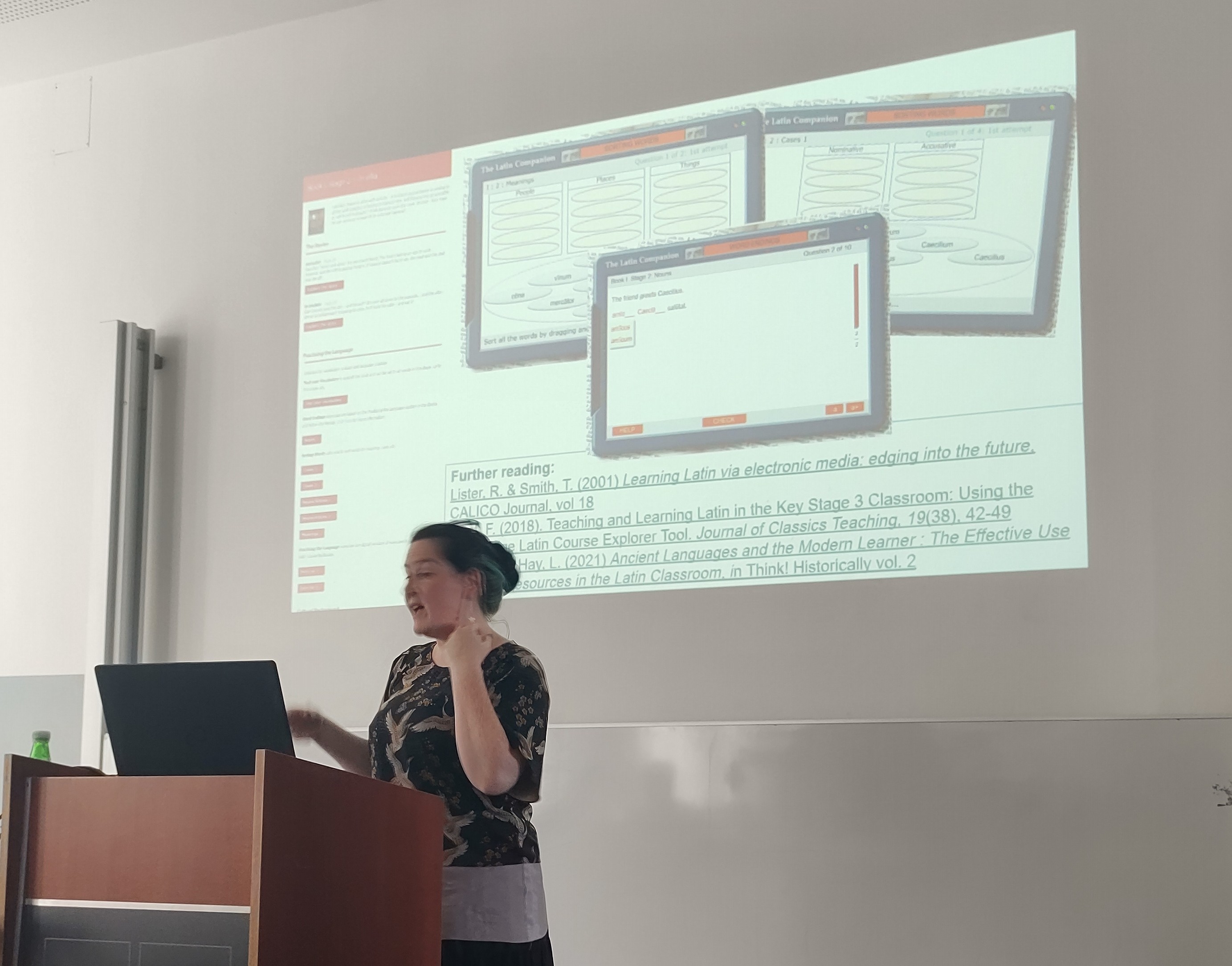
Above, Lisa Hay from the Cambridge Schools’ Classics Project discusses the much-celebrated revamp of the Cambridge Latin Course.
Above, Our host, LMU's Markus Janka, presents the varied tradition of Ovid in education.
Above, Markus and his colleagues have published this Latin translation of Suzanne Collins’ 'Hunger Games' (complete with a Latin-German vocab guide).

Above, Raimund Fichtel describes the Classics teacher training programme at LMU and the top-up days which teachers from across Bavaria can attend at the university to keep them up-to-date with research and to share ideas and approaches.

Above, Berkan Sariaydin on the tradition of Virgil’s 'Aeneid' within education.

Above, pupils from the Gymnasium Schäftlarn near Munich, with their Latin teacher Michael Stierstorfer. The students gave excellent presentations on their research projects into various classical reception topics.
Above, the programme for Mythological Education in Britain and Germany.

We also had the opportunity to visit Wilhelmsgymnasium, a secondary school in Munich with a fine tradition of teaching Latin and Classical Civilisation. Many thanks to everyone who made us so welcome and let us crash the classes! And a big thank-you to everyone at Ludwig Maximilian and at Cambridge's Faculty of Education for bringing it all together.

Munich is sometimes called the most northerly Italian city - for its great tradition of Classics and neoclassicism. A trip there wouldn't be complete without a visit to the city’s superb museums, so Steve and I had a very enjoyable trip to the Staatliche Antikensammlungen, which holds Bavaria's extensive collections of antiquities from Greece, Etruria and Rome. Many thanks to curator Astrid Fendt for showing us around. We will have more news about our experiences with the Munich collections in due course…
Finally, above, a scene of vase-making from the magnificent collection at the Staatliche Antikensammlungen.

Wednesday, 26 May 2021

Ancient Music: A Panoply Interview with Aliki Markantonatou

We're delighted to be talking to Aliki Markantonatou, an artist and music teacher based in Athens, in Greece. Aliki trained at the National Music Academy before specialising in ancient style music. We recently had the pleasure of working with her when she recorded Sappho Fragment 44 for the Our Mythical Childhood project. Aliki talks to us today about the lyre, ancient music, and cross-cultural collaboration...

1) What attracted you to ancient Greek music?
I studied piano and Western music, but I was feeling that I was missing something. Soon, I started listening to our traditional music and ethnic groups from all over the world. It was back in 2004 that I came across the lyre, and started experimenting and, a little later, playing my music on it. The need to use poetry arose and the ancient Greek poets, such as Sappho and Alkman offered me amazing lyrics of beauty. But the turning point was when I met Dr Chrestos Terzes and I realised that, yes, the ancient sound can be approached and reproduced. I was also lucky enough to attend three short seminars with Dr Stefan Hagel, and since then my interest in ancient Greek music became realistic, and not just wishful thinking. My mother is a passionate Classicist and the lullabies and fairy tales she was narrating to us were all fragments from Homer, Aesop, lyrical poetry and so on. I think that this was crucial for me to feel that antiquity is close to my heart.
Above, Aliki and other musicians at a performance of the Orphic Hymn to Hera at the Heraia festival at the Pythagorion, Samos 2016.

2) You create many projects and collaborate with different musicians. Could you tell us how you work together with other musicians and what you do?
I feel very lucky to have met so many amazing musicians and personalities because of the lyre. I participate regularly with the Lyre ‘n’ Rhapsody female ensemble, and I've performed and recorded music with Turkish musicians, Chinese, Swiss and Indian among others. The way I view the lyre is that, besides ancient Greek music, it can exist in harmony with all kinds of traditional instruments and it can be integrated in modern soundscapes. What I usually do is to study the style of the musician I am going to collaborate with and the scales of the tradition that he or she carries. The lyre is very flexible in tuning. Once I tune on the right notes, I am ready to follow and exchange musical phrases with the other artist. My main focus is to create a conversation between the instruments. As for Lyre ‘n’ Rhapsody, that is my main band, all of us create music and we work on Greek traditional songs, ancient poetry set to music and fresh compositions.

3) Your recording of Sappho 44 for Animating the Ancient World within Our Mythical Childhood has been such a great success. How did you work with Professor D'Angour's score to create the sound-scape?
That was really an amazing project, I enjoyed every moment of it! Professor D’Angour did the arrangement for the first verse, and offered me through Skype and emails all the information I needed to proceed and set to music the other three verses. He sent me the text explaining word by word the rhythm that was hidden in the vowels, the notes of the scale I could use, the proper pronunciation and instructions of what I should avoid. In the same time, he was open to my ideas and was very helpful with all the questions that arose. When I finished the first recording I sent to him and I still remember the relief I felt when he answered, yes, everything is in place….Then it was just a matter of making it really a nice piece, and I would like to thank here the amazing sound engineer Nenad Radosevic, who is always next to me with patience and ideas.


4) Could you tell us a bit about the lyre that you play?
The lyre I play is made by the luthier Nicolas Bras, who is famous for his excellent violins, cellos and all kind of repairs on instruments. It is a pretty long one, closer to varvitos (or barbitos) sound than the lyre. It has a large soundbox and 12 strings. For ancient pieces I use only 9 strings. For Greek traditional songs and other kind of music 12 strings are very helpful. I tried many combinations of strings and it took me some years to find the ideal one. I use guitar strings for the high notes and gut for the lower. It is a vintage, for sure, that can be arranged according to the project. I use a cardio mic for concerts and usually I attain wonderful sound. Still, when I can play in a place with natural amplification, such as churches, I prefer no mics.
Above, Aliki Markantonatou with her lyre.

5) With Lyre n' Rhapsody you collaborate with Meet Culture in a cultural exchange between Europe and China. What have you learned from each other?
This cultural exchange has been so deep. I could never guess the depth when it started. We were invited by Miao Bin and Eley Yuan, the founders of Meet Culture, to participate in a crossover album. Their close friend, Jang Jing, a world famous Guchen (Chinese santoor) musician received as a gift our first CD, Awakening of the Muse. She shared with us that she was playing it repeatedly until she made up her mind to visit Athens with Jang Di - an amazing Xiao flutist - and record with us. We were listening to their music for some months to get in tune; and when they arrived, we were ready. The recording happened in 5 days. We recorded 20 tracks, all of them beautiful. We chose the 10 best for the album Aegean. We learned that language is not important, just flow with the sound, trust the moment and play when is needed. We learned that we share the same dreams and can enjoy friendship with a glass of wine having Greek or Chinese food. A strong bond developed and the feeling of family is there when we meet. We joke with each other, share our problems and help and support each other. Meet Culture organised a tour in and around Shanghai for all of us and two performances in Athens. The joy of that trip and the wonderful people we met is beyond words. Elegance, care, passion, generosity, kindness to name a few. And then another surprise occurred! Discussing the poetry of ancient Chinese and ancient Greek poets we found so many things in common, we could not resist. We created a performance in which ancient Chinese and Greek poems interact, one after the other in a dialogue of similar ideas and values. It was not easy to do all this translation, but was worth it, and I can assure that you can find many poems in similar forms between these two nations.
Above, the poster for Meet Culture's celebration of ancient Greek and ancient Chinese music and poetry.

6) Who's your favourite ancient Greek?
What a wonderful opportunity to praise Pericles!!! As an Athenian woman I enjoy Acropolis energy and light! Athens wouldn’t be what it is if the area around Acropolis did not exist. It would be just another town… But, now is an amazing town!!! When I feel tired or sad, I just stroll around Acropolis and feel refreshed and encouraged - thanks to this wonderful soul who managed to challenge the citizens to create this beauty! Thanks to this wonderful soul who offered equality to his spouse Aspasia, and respected democracy, I am enjoying my life in Athens, me, one person out of million people who live here and are showered by the grace of the golden ages. I am always amazed by what Pericles inspired in so many generations!


Many thanks to Aliki for these fascinating insights. Below you'll find some further examples of Aliki's performances and her interview with a Greek lyre-maker working with traditional techniques.


Above, from the 2016 Aegean Music Tour in China.

Above, Meet Culture's Greek and Chinese collaboration on a performance of The Iliad.


Above, a Meet Culture interview in which Aliki Markantonatou talks to lyre-maker Yiannis Stathakos in Xerokampi, near Sparta, about traditional lyre-making techniques.

You'll find more videos of Aliki's performances on her website: https://www.alikimarkantonatou.net/videos
and on Meet Culture's site: https://www.meetculture.com/media

Sunday, 25 April 2021

New Animation Extravaganza!


Hooray for new animations! We are delighted that we have new animations for you – all the videos made for the Our Mythical Childhood project are now online! You can find them on their own page on the Panoply website: http://www.panoply.org.uk/omc.html . There are five new vase animations: Sappho 44, Heracles and the Erymanthian Boar, Dionysus, Libation, and Iris- Rainbow Goddess. There are two mini-documentaries: About Sappho 44 and About Heracles, and a brand new recording of Sappho 44 sung in ancient Greek by Aliki Markantonatou according to the score written by Prof. Armand D'Angour – a version of the tune that the poem would have been sung to in antiquity. You will also fine a wealth of bonus material – information about the vases and the animations, downloadable information and activity sheets, and PowerPoint presentations to help integrate the animations into lessons and lectures. We hope you have fun exploring these resrouces and trying them out.

Above, Panoply's Sonya Nevin concentrating hard during the online launch of the Our Mythical Childhood animations and Panoply's new partnership with the Cambridge Schools Classics Project.

Many thanks to everyone who attended or spoke at the launch event for the videos. In addition to introductions to the videos, we heard from Our Mythical Childhood Principal Investigator Professor Katarzyna Marciniak, from Lisa Hay, Olivia Gillmann and Rob Hancock-Jones on their pioneering teaching with Panoply vase animations, and from Head of CSCP Caroline Bristow about where the OMC animations, videos and other resources can fit into the UK and Irish curriculums. It was great to see lots of positivity and creative teaching practice.

This event also marked the launch of our new partnership with the Cambridge Schools Classics Project - a long-standing organisation at the University of Cambridge committed to supporting classics teaching. In due course, CSCP will be hosting our website - it will remain at the same www.panoply.org.uk address but will get a revamp and some extra materials. More on that as it happens. All the Our Mythical Childhood materials will soon be available on the Our Mythical Childhood website too – where you'll also find links to the other supercool projects under the OMC banner.

As you've reached the Panoply blog, I'm going to take the opportunity to point out some of its highlights. You can explore simply by scrolling through or using the Labels on the right of the page, but to jump straight in, you might fancy:

Ancient pottery meets ancient theatre, an interview with Dr Rosie Wyles

On Greek Myth Comix, by classics teacher and comic-maker L.E. Jenkinson-Brown

Symposiums, an interview with vase king Prof. Sir John Boardman

On Ancient music, an interview with Prof. Conrad Steinmann, who provided music for the OMC animations Dionysus, Libation and Iris.

You'll also find discussions of events, vases, and other art related to classical culture, such as:
Black and White Andromeda - a discussion of the representation of the Princess of Ethiopia, from ancient vases to modern young people's literature.
Happy Birthday Panoply - a potted history of our adventures with vase animations.

The Force Awakens Greek Vase Scenes - a look at Star Wars-Greek Vase fan mash-ups.

A big thank-you to everyone who has contributed to creating the Our Mythical Childhood videos. We hope you have a great time using them.