We are pleased to share the release of Teaching Ancient Greece: Lesson Plans, Animations and Resources! This Open Access volume (that is, free to download) has been published by the University of Warsaw Press. It’s bursting with ideas from the Panoply Vase Animation Project and an international team of fantastic contributors to whom we’re very grateful.
1) What’s it all about?
In short, Teaching Ancient Greece is a set of resources and lesson plans to complement the vases animations and documentaries that we made for the project Our Mythical Childhood. The Reception of Classical Antiquity in Children’s and Young Adults’ Culture in Response to Regional and Global Challenges. The resources and lesson plans are ready to use and can of course be adapted for the particular circumstances of each learning environment. The videos are:
2) What topics does it cover?
Pottery gives us insight into all sort of areas of life, so this collection connects with many topics. As well as pottery and art history, there's material on ancient religion and sacrifice, music, museums, curators and collections history, poetry and other forms of creative writing, the origins of drama, relationships and marriage, hunting, war, Latin and modern foreign languages, anthropology, and more.
Above, Sonya Nevin of the University of Warsaw and the Panoply Vase Animation Project with Teaching Ancient Greece in the National Museum in Warsaw - which houses the vases that the volume is based on.
2) What activity sheets are there in Teaching Ancient Greece?
You’ll find info and activity sheets covering:
• The Greek alphabet.
• A chronology of Greek pottery.
• A guide to Greek pottery shapes, illustrated by Steve K Simons.
• A guide to gods and their symbols.
• An activity sheet for matching gods to their symbols.
• Various blank vase shapes for creating new designs or copying existing designs to improve close visual reading and attention to detail.
• Line drawings of existing vase designs to colour, for younger learners and those who enjoy the relaxation of colouring; these can be made into feisty gifs.
• There’s an activity sheet for creating a scene from Sappho’s poetry.
• The musical score to Sappho 44, determined by Armand D’Angour of Jesus College, Oxford. Play your own version of it.
• A blank storyboard for planning new vase animations, as well as example storyboards which were used to plan Panoply’s Our Mythical Childhood animations.
• A huge set of stop-motion figures by Panoply’s Steve K Simons to make animations with.
• As well as activity sheets, each animation comes with a PowerPoint about the vase and its subject and there are bonus PowerPoints about the work of museum curators and about the Greek Gods. All these can be downloaded for free from the Panoply site.
Above, part of Teaching Ancient Greece's info page on ancient Greek vase shapes.
3) What are the lesson plans about and who designed them?
Created by experienced educators, each lesson plan contains an introduction, a lesson including one of the vases and its animation, and an exciting activity to extend the learning experience. The target audience is secondary school pupils, but the lessons can all be adapted for older or younger groups. The book takes you through lesson plans introducing pottery, through topics connected to the five animated vases, onto museum themed sessions, and then into stop-motion. Let’s look at what’s in there:
Pottery
In the chapter Understanding Vases, Warsaw/Panoply’s Sonya Nevin offers an intro to the uses, styles, and shapes of ancient Greek pottery, with lessons to embed that information, including activities with clay.
Above, painted pottery sherds created by trainee teachers at the University of Cambridge Faculty of Education practicing a pottery lesson in Teaching Ancient Greece. Drawing vase scenes, especially on clay, is a great way to improve attention to visual detail and to clarify the difference between red and black figure techniques. Creating new designs synthesises what has been learned about ancient culture.
Sappho
The Sappho chapter features Rob Hancock-Jones of Townley Grammar School in the UK. He used the Sappho animation to develop a lesson on marriage and relationships in ancient Greece. This is a particularly good fit for the Love and Relationships part of OCR’s Classical Civ. A-Level.
Igor Cardoso of Colégio Santa Amélia in Brazil created a lesson about Sappho which encouraged young people to think about facing difficult situations and emotional resilience. His students wrote short stories and poetry about Andromache and the Trojan War.
Ancient music specialist Aliki Markantonatou in Greece created a lesson that is a step-by-step walk through composing lyric poetry. This complements her unique recording of Sappho 44, which you can hear along with the Sappho animation and documentary.
Above, the Sappho chapter with the Sappho vase it was based on (National Museum in Warsaw 142333).
Dionysus
For the Dionysus section, theatre facilitator Olivia Gillman in the UK used the Dionysus animation as the basis for a drama class. Students acted out the vase scene and created improvisations around ancient theatre.
Chester Mbangchia, teaching in Cameroon, created a lesson that introduces Dionysus, god of drama, wine, and transformation. All drama students must learn about the origins of ancient theatre. This chapter and its videos provide an effective introduction to drama and how it developed.
Above, the Dionysus chapter with its vase (National Museum in Warsaw EXC243) and the storyboard that was used to plan its animation.
Libation
For the Libation chapter, Sonya Nevin created a lesson plan that teaches about the iconography of ancient gods and how they can be recognised – useful for ancient religion and for art history. This accompanies the Libation animation, which shows the gods Zeus and Athena performing a libation sacrifice.
Michael Stierstorfer of the Gymnasium Schäftlarn, near Munich in Germany, used the same animation in a lesson about sacrifice in ancient Greece: what was done, how, and what it all meant. Animal sacrifice is often a more familiar concept to learners than libation, so a lesson that explores what libation is in the context of sacrifice can be really useful. Dr Stiefstorfer’s lesson also features a Latin language element – that can be included or skipped over according to what best suits the class working with it.
Above, Libation, a visual resource for demonstrating this form of ancient liquid sacrifice. Teaching Ancient Greece has two lessons connected to this vase and its animation and you'll find its PowerPoint on the Libation page of the Panoply site.
Iris Dean Nevin, a teacher in Switzerland, brings us a writing challenge for younger learners. This session would also work well as a modern foreign language exercise. The class learn about the messenger god Iris and then write a message for her to carry.
Terri Kay Brown of Westlake Girls School in New Zealand (Aotearoa) created an introduction to anthropology. This is a chance to compare different cultures’ myths about the rainbow and to consider what is indicated by the differences and similarities between them.
Iris features in the Iliad more than you might expect. This chapter includes an info page featuring some passages in which she appears and a list of all her appearances. For study of the Trojan War, this can be an effective way to think about the relations between gods and mortals.
Above, a beautifully decorated Iris, by Temperance in Ireland, with the Iris vase (National Museum in Warsaw 142289).
Heracles Jessica Otto, then in Germany, now in St. Catherine's British School in Athens Greece, uses the Heracles animation to show how stories can be represented and decoded through visual clues.
Barbara Strycharczyk of Strumienie High School in Józefów, Poland, established a project for pupils in multiple years of the school who worked collaboratively to research the hero Heracles: they studied his adventures, they made maps, they wrote newspaper reports, they made mathematical models, they drew pictures, and it all came together in a multi-year group exhibition.
Above, Heracles, club in hand, with the defeated Erymanthian Boar, by a pupil at Strumienie High School, Poland.
Museums
Museum educator Jennie Thornber, at the Fitzwilliam Museum in Cambridge, UK, created a session for exploring museums in person or online and taking on the role of a curator. This is a great lesson for learning to use material sources as evidence, understanding what curators do, and building confidence about using museums and their websites. A PowerPoint on the Panoply site is one of several providing extra support for these activities.
Louise Maguire of Blackrock College, Dublin and the Classical Association of Ireland Teachers sets a more detailed museum challenge. In the role of curators, students plan exhibtions, considering extra factors such as audience, marketing and communication, budget, and accessibility - a creative challenge that drops students virtually into the world of work asking them to consider others and to think about what they have learned and how they can communicate their knowledge effectively.
If all these animation-orientated activities make you feel like having a go at making your own stop-motion animation, look no further. Christina dePian, a museum educator based in Greece ( https://www.kinoumeno.gr ), provides a detailed and accessible guide to making stop motions. There is information about stop-motion equipment and a lesson plan that goes through the steps of making an animation with a class (or making one yourself). Accompanied by a set of animation resources, this guidance makes it easy for anyone from 5 to 105 to try animation and create their own version of antiquity.
Above, with the stop-motion figures and guide, anyone can give ancient world stop-motion a go.
Teaching Ancient Greece is an action-packed set of resources to make learning enjoyable, challenging, and memorable.
Thanks again to everyone who made it possible through contributions, editing, reviewing, artwork and more, and to the European Research Council for generously funding it. We hope you enjoy exploring the ancient world with it!
Above, l-r at the University of Warsaw, Elżbieta Olechowska, Katarzyna Marciniak, Sonya Nevin, and Steve K. Simons. Below, Sappho Fragment 44. The Marriage of Hector and Andromache
Spring is here! And with it – a free book! The latest publication from Our Mythical Childhood is Classical Mythology and Children's Literature... An Alphabetical Odyssey, by Elizabeth Hale and Miriam Riverlea. An exciting bonus – it’s illustrated by Panoply’s very own Steve Simons!
Alphabetical Odyssey takes you on a journey through the oceans of children’s books inspired by ancient Greek and Roman mythology. The 26 chapters discuss elements important in literature for young readers, providing insights into how mythical adaptations, retellings, and allusions connect with aspects of childhood and adolescence. The chapters are arranged alphabetically, such as E is for Emotions, J is for Journeys, N is for Nature, and O is for the Olympians, and each comes with their own illustration.
You can download a free copy here. Share the download link as much as you like. The book will have a special appeal to anyone interested in classical mythology, classical reception, and/or young people’s literature.
You can find other free downloads from the Our Mythical Childhood series, and hard copies of the books available for sale
here
All too soon, they will be joined by Teaching Ancient Greece: Lesson Plans, Vase Animations, and Resources, a book based around Panoply’s Our Mythical Childhood animations featuring 15 lesson plans by teachers from all over the world and all sorts of bonus resources to go with them. We’ve been working on that for a good while now and can’t wait for you to see it. Watch this space for news. If you’ve managed to miss the OMC animations and documentaries, take a look here: https://www.panoply.org.uk/our-mythical-childhood
We’ve had a busy start to the year. January saw us at the Allard Pierson Museum at the University of Amsterdam in the Netherlands. Panoply’s Sonya Nevin was there to present at the Ancient Vases in Modern Showcases conference, organised by Laurien de Gelder and Vladimir Stissi. Kate Cooper of the Royal Ontario Museum gave a stonking key note speech, outlining all sorts of factors that must be considered when planning a vase gallery or exhibition. Consider even the difference between arranging vases chronologically, arranging them by type of vase, displaying artefacts according to their decoration to express themes such as Trojan War, Sport, or Warfare, or the effect of grouping similar objects from different cultures. These are all solid options, yet they create a different experience for the museum visitor and a different impression of the objects and their meanings.
We also heard from Jill Hilditch, who has tackled the display of prehistoric ceramics and objects with unknown functions. You may recall the interview that Dr Hilditch did for Panoply a little while back discussing her research project, Tracing the Potter’s Wheel. Sally Waite and Olivia Turner presented a public programme, You Echo Through Time, which they ran at the at the Great North Museum in the UK, helping modern women explore their own experiences through an artefact-based search for the voices of ancient women. David Saunders of the J.Paul Getty outlined the approach that will be taken in a forthcoming exhibition, placing Mayan, Moche, and ancient Greek ceramics beside one another to prompt reflections and comparisons. One to look out for.
Above, David Saunders outlines the ideas involved in the Getty's forthcmoing exhibition of Mayan, Moche, and Greek Pottery
Sonya’s presentation outlined the way in which vase animations provide a bridge between the museum and the wider community – creating opportunities for people to see artefacts outside the museum space – seeing them in a new form in the classroom, in theatres and cinemas, projected onto walls, on tablets in parks – all sorts of spaces - and offering a prompt for further creative engagements with the artefacts, be it drawing, pottery-making, poetry, storytelling and more besides. Enjoying an ancient artefact does not have to mean simply looking at it; seeing can be only the beginning.
Above, Vases beyond the museum: a school event in Poland sees teens watching Panoply vase animations in a theatre before giving their own research presentations and making their own ceramic designs.
Sonya recently gave a different sort of talk closer to home in Cambridge, at the Digital Education Futures Initiative ( https://www.deficambridge.org/). This initiative, developed at Hughes’ Hall, Cambridge, creates opportunities for developing new models of education and new research priorities arising due to the growing prevalence of digital technology. Recent talks have explored digital tech’s ability to harness collective intelligence; Camtree, also based at Hughes’ Hall, which creates opportunities for teachers to conduct and share research and improve learning outcomes; and Sonya’s presentation on how digital technology has enabled new insights into the study of ceramics and ancient iconography.
We will have more news for you soon. Coming up are a new About Dionysus documentary to complement our Dionysus animation; news on an exhibition in the US that we've contributed to; and insights into the Islanders exhibition, which is on now at the Fitzwilliam Museum in Cambridge.
We are delighted to share our new documentary with you: About Iris – Rainbow Goddess. This mini doc is a companion piece for the Iris animation. Both can be found on the Iris webpage, and they’re shared here for your convenience too:
For the last year or so, we have been busy preparing a publication to complement the Our Mythical Childhood animations. Teaching Ancient Greece: Lesson Plans, Animations, and Resources is a collection of lesson plans based around the five Our Mythical Childhood animations. They have been prepared by experienced teachers from all over the world. Every lesson plan contains guidance for delivering a class and an interesting and challenging activity. The lesson plans have been brought together with further resources to support teaching about antiquity, including materials about pottery and resources for making your own animations. The Iris section contains lesson plans by Kay Brown in New Zealand, taking a cross-cultural look at mythology, and by Dean Nevin in Switzerland, introducing a messenger themed writing challenge for younger children. As a bonus, Teaching Ancient Greece will be available as an Open Access publication, meaning that it can be downloaded for free. A hard copy will be available to purchase for those who love a physical book! We’ll have more news for you as the publication date approaches.
Above, a screenshot from 'About Iris', also found in 'Teaching Ancient Greece' in a section on Iris in 'The Iliad'.
In other news… a throwback to earlier in the summer. We took a trip to Ludwig Maximillian University of Munich, in southern Germany. The conference Mythological Education in Britain and Germany was part of the University of Cambridge-Ludwig Maximilian Strategic Partnership: an opportunity to visit each other’s universities and share good practice in Classics teaching and teacher training. Here are some images of the event:
Above, Panoply’s Sonya Nevin talking about using vase animations in the classroom.
Above, Emily Rushton describes ways of making Classics more inclusive, particularly for those who are neurodivergent.
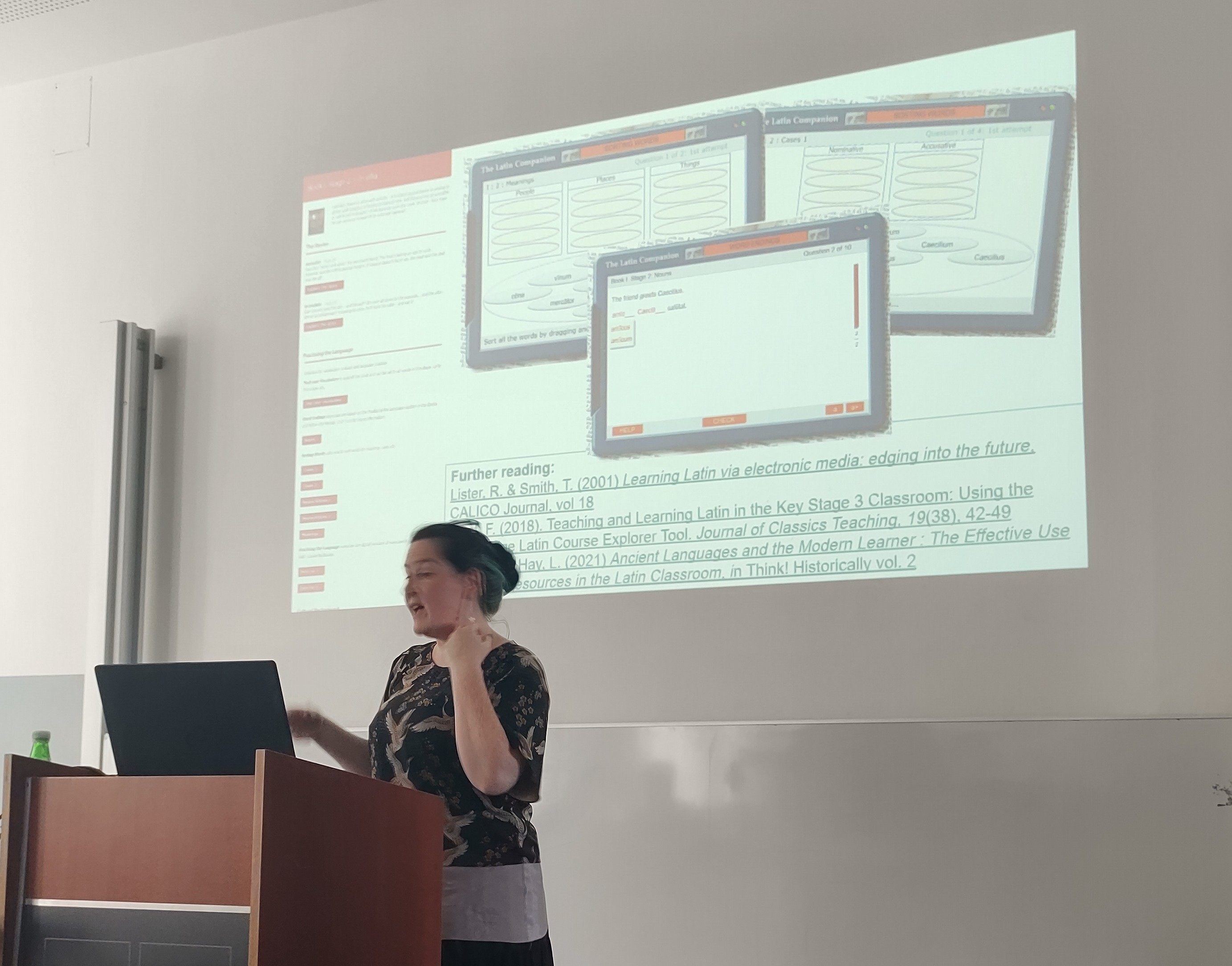
Above, Lisa Hay from the Cambridge Schools’ Classics Project discusses the much-celebrated revamp of the Cambridge Latin Course.
Above, Our host, LMU's Markus Janka, presents the varied tradition of Ovid in education.
Above, Markus and his colleagues have published this Latin translation of Suzanne Collins’ 'Hunger Games' (complete with a Latin-German vocab guide).
Above, Raimund Fichtel describes the Classics teacher training programme at LMU and the top-up days which teachers from across Bavaria can attend at the university to keep them up-to-date with research and to share ideas and approaches.
Above, Berkan Sariaydin on the tradition of Virgil’s 'Aeneid' within education.
Above, pupils from the Gymnasium Schäftlarn near Munich, with their Latin teacher Michael Stierstorfer. The students gave excellent presentations on their research projects into various classical reception topics.
Above, the programme for Mythological Education in Britain and Germany.
We also had the opportunity to visit Wilhelmsgymnasium, a secondary school in Munich with a fine tradition of teaching Latin and Classical Civilisation. Many thanks to everyone who made us so welcome and let us crash the classes! And a big thank-you to everyone at Ludwig Maximilian and at Cambridge's Faculty of Education for bringing it all together.
Munich is sometimes called the most northerly Italian city - for its great tradition of Classics and neoclassicism. A trip there wouldn't be complete without a visit to the city’s superb museums, so Steve and I had a very enjoyable trip to the Staatliche Antikensammlungen, which holds Bavaria's extensive collections of antiquities from Greece, Etruria and Rome. Many thanks to curator Astrid Fendt for showing us around. We will have more news about our experiences with the Munich collections in due course…
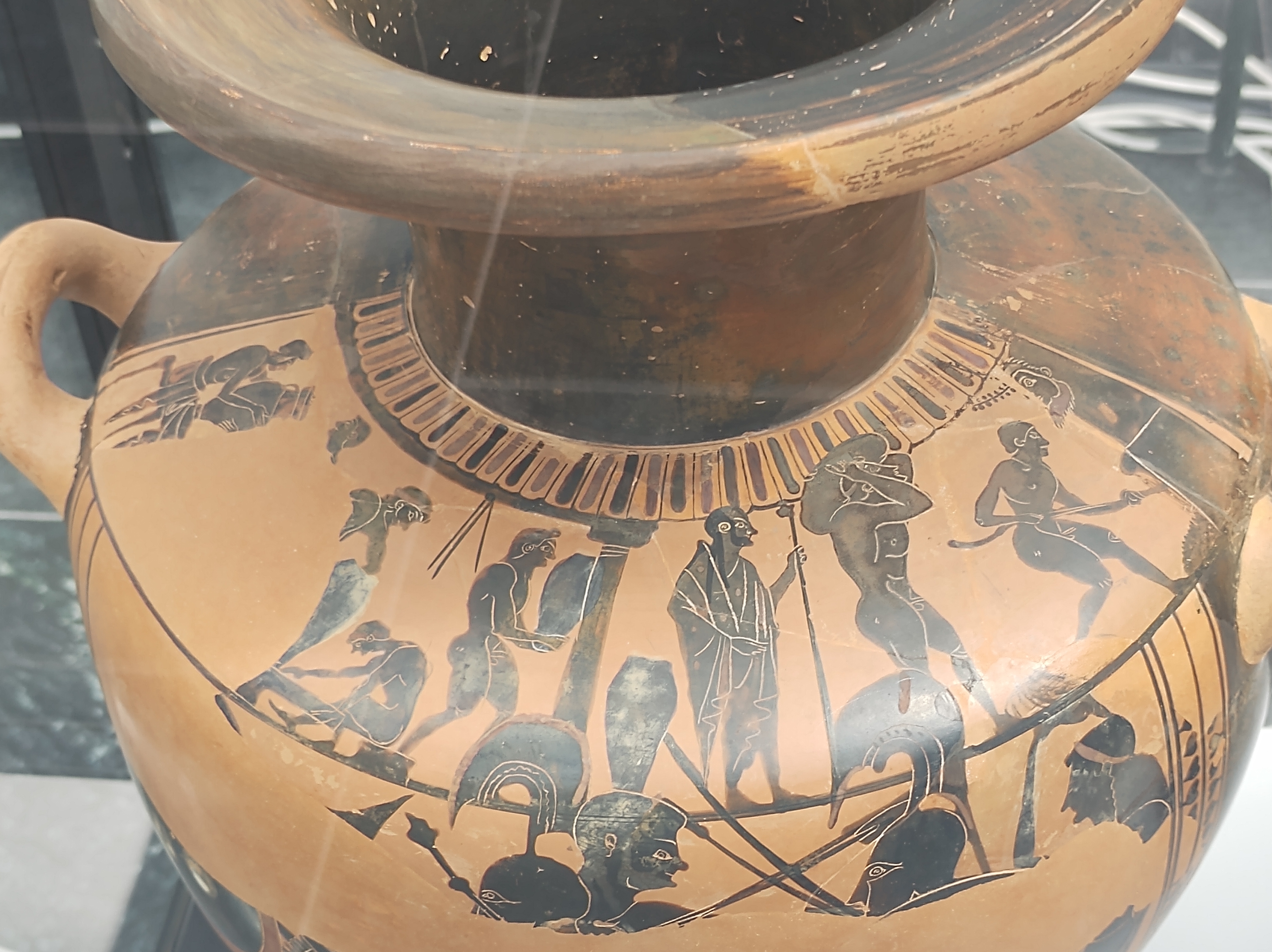
Finally, above, a scene of vase-making from the magnificent collection at the Staatliche Antikensammlungen.
Good news vase fans! Lots of interesting things coming up. It is finally the time to launch online the new animations that we've been making for the ERC-funded project Our Mythical Childhood... The Reception of Classical Antiquity in Children’s and Young Adults’ Culture in Response to Regional and Global Challenges. They'll be launched at a free online event on Saturday 24th April. This event will be an interesting and enjoyable affair. Along with the animations there'll be short talks about them, presentations from teachers who have been trialling them in the classroom along with their bonus resources, a performance of ancient music, and a chance to see the short 'About' videos that accompany the animations. Registrations can be made here: https://www.teaching.cambridgescp.com/animating-ancient-world. Pop back here soon (or keep your eye on our FB page) for more info on the schedule.
You might notice that the booking page is a University of Cambridge address – that's because (*drumroll*) the Panoply Vase Animation Project is going into partnership with the university's Cambridge Schools Classics Project (CSCP:
https://www.cambridgescp.com/). They've been supporting classics teachers for many years and we're pleased that this partnership will help us to help teachers more than ever. Our website will be migrating to CSCP (still at the same web address tho), so look forward to a new layout and cool new materials. In anticipation, here's the Iris animation, which got a forward release:
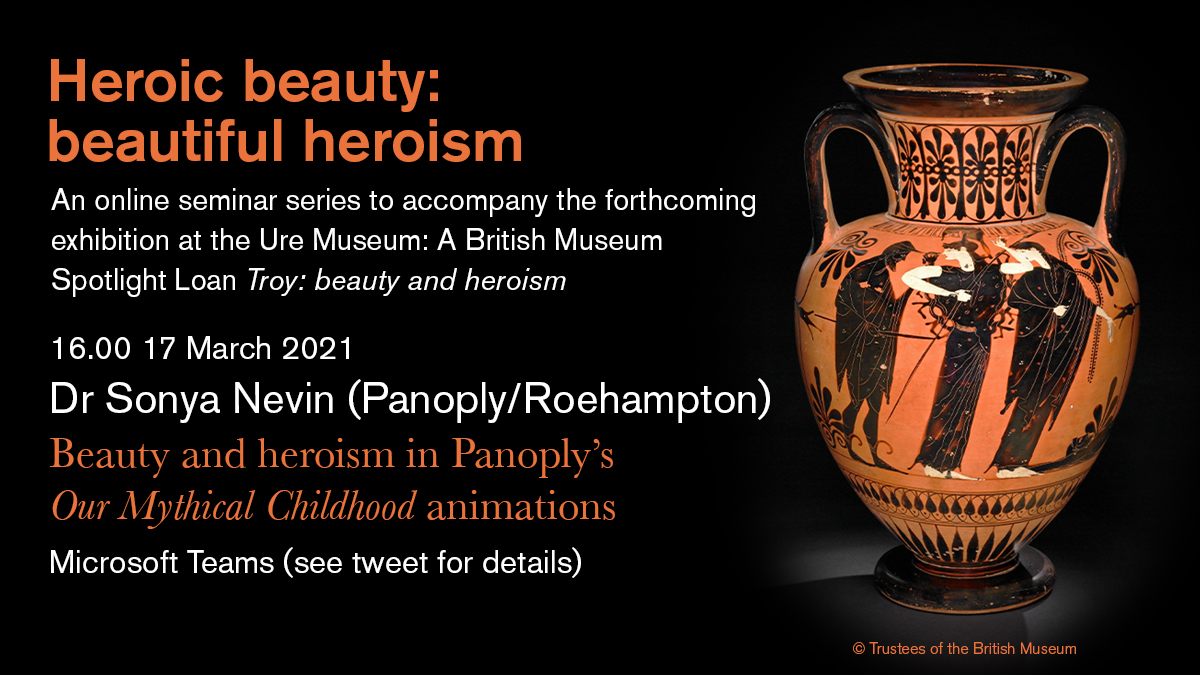
There will be an even earlier opportunity to hear Panoply's Dr Sonya Nevin talking about 'Beauty and Heroism' in the animations. Sonya will be giving a talk at 4pm GMT Wednesday 17th March as part of the University of Reading's Heroic Beauty: Beautiful Heroism series. The link to the talk and info about other talks in the series can be found here .
In other good news, Sonya's book, Military Leaders and Sacred Space in Classical Greek Warfare is coming out in paperback after going down well in hardback. It's published by Bloomsbury and available at: https://www.bloomsbury.com/uk/military-leaders-and-sacred-space-in-classical-greek-warfare-9781350247130/. Take a look! This coincides nicely with Sonya completing her second book - a deep dive into the Battle of Marathon - why it happened, what happened, and how it influenced society in the weeks, years, and then centuries after the battle. More on that as things unfold, and a high-five to everyone at Bloomsbury who have been so supportive during the writing of the book.
Hope to see you at the talk on Wednesday and for good times in April.
In this latest interview we're delighted to be speaking to Dr Jill Hilditch, Associate Professor of Archaeology at the University of Amsterdam. We're getting super up close with pots! Dr Hilditch is the Principle Investigator on a research project at the Amsterdam Centre for Ancient Studies and Archaeology (ACASA): Tracing the Potter's Wheel. Investigating Technological Trajectories and Cultural Encounters in the Bronze Age Aegean (2500-1200BCE) https://tracingthewheel.eu/. You're in for a fascinating read finding out how archaeologists go about their analysis of the world of pots...
1) How can an archaeologist tell where a pot came from?
Whether it’s your favourite tea mug or a 5000 year old wine goblet in a museum, all ceramic pots are essentially made from clay and water (with a few occasional additives!). These clays are the naturally occurring weathering products of many different types of rocks and sediments, and it's this link to the geological environment that allows us to study where a pot came from. We use microscopic and elemental analysis techniques developed within geology to identify the tiny bits of weathered rock and minerals within the ceramic paste and try to see if these components match the geological environment where the pot was found. By establishing local compatibility with the sediments and rocks at a site, we have a solid basis for making our interpretations on whether that pot was made locally or was imported. Finding out where potential imports come from relies upon finding a suitable match with published ceramic fabrics from other sites. Of course, humans always complicate things and making a clay paste suitable for producing a pot often means altering the geological sediment. This can be done either by adding temper to the clay, or fining the natural clay through crushing, sieving or water settling (levigation). All these human behaviours affect the appearance and contents of a ceramic fabric but, luckily, we’ve also got quite good at identifying these important behaviours in the manufacturing process!
Above, Jill getting stuck into some microscopic analysis.
2) How did people make pots before the invention of the potter's wheel and what is it that the wheel offers that tempted potters to make the switch?
Before the wheel, ceramic pots were built by hand. Perhaps the most ‘low-tech’ method of all is the pinch method, where a potter takes a lump of clay, makes an indentation with their thumb and then uses a pinching motion with their thumb and forefinger to push the clay into the desired form. Several other hand building methods use this pressure principle but achieve it with a range of different tools, such as paddles and anvils, or you can shape or mold the vessels around other pots to create similar shapes or standardise the size of the pots. One of the most common hand building techniques we see in prehistory is coiling, where coils or snakes of clay are rolled out and then stacked on top of each other to build the pot. These coils are then joined together by pinching before being smoothed to create the wall.
Studies by Valentine Roux and colleagues working on the Near East from the 6th and 5th millennia BCE show that the use of a rotating device for potting first appears in combination with coils. This use of rotative kinetic energy (RKE) would have helped with the addition of coils, as well as the thinning and shaping of the walls of the vessel, allowing the potter to be stationary rather than ‘orbiting’ the vessel. This is why we refer to early pots as ‘wheel-fashioned’ because the invention of the potter’s wheel did not go hand-in-hand with the innovation of wheel-throwing: the first use of rotating devices was not to ‘throw’ a pot from a solid lump of clay but to help fashion or finish a coiled rough-out of a vessel. The rough-out was placed onto a wheel head (those that have survived in the archaeological record are made from stone or fired clay) which could rotate in a socket in the ground or a raised pivot. Unfortunately, there is scant material evidence for most of the devices used for potting in the past, probably because many of the components for the wheel device were made of wood and other organic materials that have not survived in the material record.
So, we're left with an interesting puzzle – why did potters switch from hand building to wheel-fashioning techniques and how did the innovation of wheel-throwing emerge from these beginnings? A common argument is efficiency: simply put, the potter’s wheel allows potters to produce more vessels in a shorter timeframe than hand building techniques, thereby laying the foundation for increased production levels and labour specialisation. This is perhaps true for wheel-throwing, but the use of a wheel to fashion or finish a coil-built rough-out is remarkably difficult and would have, initially at least, represented a greater investment of time for skill acquisition and tool creation by the potter. There is also an argument that the wheel afforded the production of better-quality vessels too, though anyone who has ever seen the eggshell-thin vessels of Kamares Ware alongside the crudest of wheel-coiled conical cups on Crete may disagree! Our project decided that it was perhaps a good idea to investigate which shapes were made using the wheel, as well as which wheel-based method and by whom (were these locally trained or itinerant potters?), in order to shed new light on this puzzle.
3) Your project is examining the transmission of knowledge of the potter's wheel – how was knowledge of the potter's wheel transmitted?
Our Tracing the Potter’s Wheel (TPW) project focuses on the use of the potter’s wheel within the forming stage of the ceramic production sequence. This sequence, known as the chaîne opératoire, is used by archaeologists to consider the choices (deliberate or unconscious) made by the potter throughout the entire manufacturing process. The chaîne opératoire goes from raw material sourcing and processing to create a suitable paste, through to the forming technique, the surface treatments applied to the formed pot, and the final firing process. The choices made by a potter are a window into their social and cultural context, as the gestures, skills and know-how the potter needs are learned by watching, copying, and participating with their peers in the production process. This group is called a community of practice and they are identified through the similarities in the production sequence, which are materialised in the pots they produce. Archaeologists are becoming increasingly aware that these shared practice-through-knowledge groups can be traced in the material record, opening up new possibilities for tracing technologies such as the potter’s wheel.
Above, a charming example of Minoan pottery.
Some of this know-how is easier to learn than others; for instance, decorative styles can be transferred by simply watching another potter at work, or even recreated from seeing one of their finished pots. For the forming stage this is often a much harder process: not only is the method of making the pot invisible in the finished vessel but so are necessary physical gestures and the tool-kit too. For this reason, the transmission of the potter’s wheel is one of the surest indicators we have for potting specialists interacting with one another for sustained periods of time. This is why it is so crucial to determine if a wheel-made pot was produced locally, or simply imported from another production unit, because we need to establish if a person with that skill-set was working at the site where the vessel was found. If we are ever to explore how the wheel emerged as a technological innovation, and how it spread between these communities of practice through time, then we need a clearer understanding of who was using it, where and in what way.
Above, Minoan pottery with bonus octopus.
In the case of the Bronze Age Aegean, the appearance of the wheel was considered as two potentially independent events, connected to two different horizons of intensifying cultural contact. The earliest identified horizon of wheel use appears during the later Early Bronze (EB) II period (c. 2500-2100BCE), known as the Lefkandi I/Kastri phase, widely thought to indicate increased trade in metals between social groups in the Aegean and (predominantly) western Anatolia, where the potter’s wheel is known to have already been in use. In the later transition, from the Middle Bronze (MB) to the Late Bronze (LB) period (1800-1600BC), the potter’s wheel is considered as a technology of the Minoan culture of Crete, spreading beyond the shores of Crete as part of a package of technologies indicating growing Minoan power and influence, the so-called ‘Minoanization’ of the southern and central Aegean region. Our project has recently reassessed diagnostic traces of wheel use within late MB and early LB Cretan, and non-Cretan but ‘Minoanized’ ceramic assemblages (collections of ceramics found at the same site) – we've shown that the combination wheel-coiling technique continues to dominate the ceramic record. This would indicate that wheel-throwing is necessarily a later technological development than LB I within the Aegean. This transition from wheel-coiling to wheel-throwing remains poorly understood in Aegean archaeology and beyond, yet is critical for investigating how knowledge of the potter’s wheel was transmitted between communities of practice.
Above, Jill introduces the project in a short video.
4) What approaches have you taken to find that out?
The TPW project has brought together an experimental archaeologist (Dr Caroline Jeffra), a digital archaeologist (Loes Opgenhaffen) and me, a ceramic fabric specialist, to investigate the transmission of the potter’s wheel in the Bronze Age Aegean. Caroline has carried out a systematic programme of experiments to explore the macrotrace evidence for wheel-coiling and wheel-throwing in the Bronze Age Aegean. She designed and produced a ceramic type set to improve our ability to differentiate between these two specific wheel use strategies and then applied the results to the study of archaeological ceramics from the Bronze Age Aegean. This enabled her to establish the range of diagnostic traces associated with each specific wheel-forming technique. Using a Dino-Lite digital microscope, I recorded the ceramic fabrics of the wheel-made vessels (identified by Caroline) to determine which vessels were compatible with local production and which were imported to the site under study. Loes has also been busy using a DAVID structured light scanner to make 3D models of the experimental pottery typeset and reproducing some of these vessels in macro form through 3D printing to serve as teaching aids. Loes’s 3D models, alongside Caroline’s macrophotographs of wheel traces and production videos of the experimental pots, as well as my fabric photomicrographs, form the core of our dataset that we want to share with other archaeologists interested in studying the potter’s wheel.
Above, Caroline Jeffra (l) and Loes Opgenhaffen (r) at work on Tracing the Potter's Wheel.
Sharing really is the key word here because we quickly realised that no single research team would be able to generate enough data within the timeframe of a government-funded project to fully understand the trajectory of the wheel in the Bronze Age Aegean. Faced with such a dilemma, we decided to focus our efforts on creating a tool-kit for other archaeologists so that they could generate their own datasets and contribute to a collaborative effort to address this large question of the potter’s wheel. We're going to publish instructions for our methods, and user manuals for the equipment we have used, to ensure compatibility of results generated by different individuals and teams in different places. In this way, we want to start a crowd-sourcing effort to solve the potter’s wheel puzzle.
Above, Minoan pottery from Akrotiri on Santorini once again showing command of shape and a flair for decoration featuring the natural world.
5) Tell us a bit about how your research is being visualised.
One of our main goals is to produce an open-access digital resource that enables other archaeologists to use our visual data, not only for learning how to recognise wheel traces but also guidelines on how to produce their own visual datasets which can then be uploaded and shared. As none of our team are database experts, and our data is so visual in nature (and also large in size!), we are working with a data consultancy team to build our own tailor-made digital data platform. We've already generated massive amounts of photographs of the archaeological pots we're studying, as well as production videos, 3D models, and more photographs of the project’s experimental pots. If we manage to secure the appropriate permits from the Greek Ministry of Culture, we also hope to supplement our platform with 3D models of key archaeological vessels, to highlight the challenges in spotting and interpreting macrotrace and ceramic fabric information, and to create a useful research resource for everyone interested in the potter’s wheel.
For now, we've been posting our annotated 3D models of the experimental pots on SketchFab , as well as discussing many methodological aspects of our techniques on our project website. Last autumn we were invited to take part in the Heraklion Museum’s Daedalus exhibition, which focused on the technologies associated with this mythical craftsperson, including the potter’s wheel. Our team designed a series of installations exploring the visual aspects of our techniques and created a hands-on touch table filled with experimental pots and 3D printed replicas to allow museum visitors to engage with our research. Without a doubt, it was one of the hardest but most rewarding experiences I’ve ever had, both as a team member on the TPW project and as an archaeologist – after all, who puts on an interactive exhibition with no archaeological material in possibly the best archaeological museum in Greece?!
Above, Tracing the Potter's Wheel at the Heraklion Museum’s Daedalus exhibition.
6) You've done some fascinating jobs in some interesting places. Could you tell us a bit about that and about what subjects you'd recommend for people interested in getting into archaeology?
I started off with a joint degree in archaeology and geology and soon found that ceramics were the perfect mix of both fields. It also helped that ceramic petrography (laboratory-based microscopic analysis of ceramics) was a valuable skill to have, as I could work in any period and region that had ceramic objects as part of the archaeological record. For my PhD I worked on ceramics from the amazing prehistoric settlement of Akrotiri on Santorini, a site with an unbelievably rich material record preserved by metres of volcanic ash (think Pompeii but 1500 years earlier). I've also been privileged to take part in the excavations and surveys of the island of Keros and the major Early Bronze Age settlement and maritime sanctuary of Dhaskalio-Kavos. Since 2006 I have been trying to work out where all the pottery on that tiny marble islet came from and it remains one of the most important and enigmatic sites in the Aegean. Working at so many projects over the years has given me an enviable perspective on the ceramic fabrics of the Cyclades and my mobility as a researcher (hello Greece, Canada, the Netherlands, the UK and then finally back to the Netherlands again) has meant that I've rarely struggled to find research projects, for which I count myself extremely lucky. I can already hear several colleagues thinking loudly about where the results of some of those projects are, but it will all come out eventually, I hope!
Above, Jill checks ceramic finds at Akrotiri on Santorini in Greece.
For those wishing to enter archaeology today, it is difficult to offer a one-size-fits-all solution. There's no doubt that modern archaeology straddles the sciences and humanities fields, which means from social science, anthropology, classics, linguistics and sociology to materials science, biology, ecology and chemistry, not to mention computing technology and heritage studies – there's a path into archaeology for almost anyone! The best archaeological science is undertaken by those who not only understand the potential and limitations of their techniques, but can also anchor their methodology within archaeological theory, which means studying archaeology at university should be considered as an option by anyone interested in the field. Commercial archaeology is also growing in a number of countries to supplement local and national government sanctioned work. In some cases those companies offer valuable on-the-job training and support those who'd like to supplement their skills with further and higher education archaeology courses. Maybe as a university lecturer I'll always see the value of this environment for awakening curiosity and developing systematic research skills. Did I also mention that most Dutch universities teach in English and are substantially cheaper to attend than some UK universities?
7) What's your favourite ancient Aegean artefact?
Besides pots?! Hmm, this is too difficult to answer definitively so I’ll mention an object category I’m excited about at the moment – textile loomweights made from clay. Some of these objects occasionally look like owls, snakes or smiley faces (especially the discoid ones) but where they really interest me is their composition, of course! Weaving and textile production has long been assumed to be a locally-based domestic industry in prehistory, yet if we study these objects from a ceramic fabric perspective, we can see that they, like pots, have been made in different places, from different clay pastes, and were moving with people across the prehistoric landscape. I had exciting plans to work with a good friend and colleague, Joanne Cutler, on her ideas about textile worker mobility in the Bronze Age Aegean but sadly she passed away a couple of years ago and those plans were postponed. Needless to say, I’m looking forward to picking up this thread again (pun intended) with other colleagues in the future and showing the importance of Jo’s work in this area.
Above, a collection of ceramic loomweights from Late Minoan Crete (c.1600-1200BCE).
Many thanks to Dr Hilditch for sharing these insights into how ceramic analysis is done and how it can illuminate wider social behaviours. It's also been inspiring to see how the Tracing the Potter's Wheel is combining different expertise and creating resources that will enrich the whole archaeological community. Below you'll find some short videos by Tracing the Potter's Wheel featuring pots being made, an introduction to petrographic analysis, and a presentation by Dr Hilditch describing the work of the project in a bit more detail. You might also enjoy visiting the Tracing the Potter's Wheel blog , which features all sorts of interesting discussions, including Why Do Archaeologists Study Pottery?.
Above, throwing a pyxis pot.
Above, Petrographic analysis explained.
Above, a short talk in which Dr Jill Hilditch introduces the exhibition 'Tracing the Conical Cup' at the Netherlands Institute at Athens.
Animation time vase fans! We're delighted to share the first of five cracking animations made as part of the Our Mythical Childhood project . Below you'll find some info on Iris and on how the animation was made, but first, buckle-up for Iris – Rainbow Goddess!
Iris is a messenger goddess. She carries messages from one god to another, especially messages from Zeus and Hera. She has wings so that she can fly fast and far. When she flies, she leaves rainbows in her wake, streaking across the sky! That's where rainbows come from. Awesome!
The ancient Greeks were always on the look-out for unusual natural phenomena – they could be a sign sent by a god. In sunny Greece, rainbows are even more unusual than they are in rainy northern Europe. Iris was often called 'storm-footed' , because storms came with her as well as rainbows. As rainbows are unusual and linked to the coming of rain and storms, ancient Greeks thought that they could even be a sign of war approaching (e.g.Homer, Iliad, 17.547 ). The poet Hesiod said that Iris was a sister of the terrible Harpies (Theogony, 265)! Still, she had a job to do and you don't hang around when you're carrying a message for Zeus or Hera! In an age when we can send messages near and far so easily, it's good to be reminded how amazing the idea of super-fast messages would be.
Above, the pot that Iris – Rainbow Goddess was made from - a hydria in the National Museum in Warsaw, in Poland (number 142289).
The pot that we made the animation from is an Athenian hydria, or water carrier, from c.450BCE. Iris is shown as if she has just landed, or is just about to take off - her knees are slightly bent, her wings up. In her hand she carries her herald's staff – the sign that she is a messenger. Her wings have been positioned very cleverly so that they fit onto the shoulder of the vase.
Above, Panoply animator Steve gets a good look at Iris at the National Museum in Warsaw.
You may have noticed – the animation also features a first for us – it's a 3D vase! We measured the dimensions of the vase carefully, then re-created it in 3D. Once we had the digital vase, the animation - made from the original vase's decoration the way all our vase animations are made - was added as a layer onto its surface. The cracks that the vase has suffered and had repaired over the years were also added back onto the vase as a layer.
Above, the vase began life as a pillar.
Above, the pillar was manipulated to match the vase dimensions. A room was created to house it.
Above, Iris is invited to the vase! Note the rainbow in her eye to draw out the Iris-eye iris connection that exists in English (and some other languages) - the iris is the coloured part of your eye which controls how much light gets in.
For the soundscape of the animation, we hear rain and the beginning of a storm – perfect conditions for Iris. With it you hear the sound of aulos pipes, played by ancient music specialist, Prof. Conrad Steinmann.
In the future, Iris will have her own page on our website along with the other Our Mythical Childhood animations. We're in the process of making some changes to the website, so for now, if you'd like to download some fun activities to do with Iris, please head on over to her page on the Our Mythical Childhood website: http://omc.obta.al.uw.edu.pl/iris
Create your own Iris with the activity sheets on the Our Mythical Childhood page.
Good news, animation fans! We're serving up a fresh animation for all your animated antiquity needs!
Here is Play Hide and Seek in Herculaneum. You may notice something a bit different... oh my goodness – it's not a pot! This is our first adventure in an animated fresco! It's been created as part of the Locus Ludi project (Locus Ludi: The Cultural Fabric of Play and Games in Antiquity, https://locusludi.ch/). It's made from a wall-painting (fresco) in a house in Herculaneum. The fresco shows a hide and seek style game being played by little eroti, mini love gods, winged children, also known as 'putti'. Locus Ludi project leader, Professor Véronique Dasen, has chosen this time to launch the animation as a gesture of solidarity with all our friends, colleagues, and everyone else in Italy and to give us all something cheerful while we're staying in and avoiding non-essential contact. You can find out more about the animation below, but let's jump straight in. Here's Hide and Seek!
Hope you enjoyed it!
Above, the fresco from which Hide and Seek was made (House of the Deer, Herculaneum).
Above, Panoply's animator, Steve, gives a sense of scale beside a fresco from the same series in the House of the Deer.
The House of the Deer (Casa dei Cervi in Italian) is a large and beautifully decorated house right in the heart of Herculaneum. The house, like the rest of the town, was badly damaged by the eruption of Mount Vesuvius in 79CE, but much of it survived, offering us fabulous insight into the living environments of well-to-do Roman citizens.
Above, Steve checks out the deer statues that gave the house its name.
Above, this interior shot gives a further sense of the house's extensive decoration.
Above, a look across the court-yard towards the main area of the house
Above, an information board from the house that tells you a bit about it and gives an impression of how massive the house is.
What's going on in the animation? We can see in the fresco that the eroti are playing a hide-and-seek style game. What kind of games did the Romans play? That is one of the key questions of the Locus Ludi project. To explore the answer, Véronique turned to an ancient author called
Julius Pollux
. Pollux was a Greek philosopher from Egypt and a Roman citizen – very international! He lived in the 2nd century CE. He studied in Athens and eventually opened a school there. He wrote ten books, one of which survives – Onomasticon – an encyclopaedia. Among the entries in his encyclopaedia, Pollux listed the different rules by which children played hiding and chasing games. As you can see in the animation, there were different ways to play. Some of them are still played one way or another, others not so much:
• Myinda is much like the game which in English we call 'Blind Man's Buff', where one player wearing a blindfold hunts the others. Pollux lists two ways of playing this game – in one version the blind-folded player simply tries to catch the others, in the second version the person who's 'it' has to guess the name of the person they've caught – a bit trickier.
• Apodidraskinda has many different names in English, such as 40:40, 1-2-3 In, and Pom-Pom 40. Players start at a base. They hide while one counts, then the hiding players try and get back to the base without being caught. Have you played this game? What did you call it?
• Chalké Muia has not survived so well. It's a chasing game. Two players must try and poke the third with slim strips of papyrus. Fun times!
Visitors to the House of the Deer would have found it amusing or at least sweet to see the fresco of the little eroti playing games that they all knew well from their own childhoods. Perhaps there were children living in that house who still loved to play them!
It was an interesting challenge to make the animation. It's not quite like animating a pot. One of the big differences was dealing with colour. Greek vases use quite a simple colour palette. Frescoes, on the other hand, were painted onto walls using a much wider range of colours. Shading was used to help create the shape of the limbs and the sense of depth. In order to have the figures turn and move their limbs, Steve took spots of colour from all over the figures' bodies to recreate them using the same tones. Once there were versions of their limbs pointing in all directions, the figures were manipulated like puppets, just as the vase figures are. One other geek-tastic detail – perhaps you've already spotted it – the font used for the game names and as speech captions: Steve created that font from the graffiti on the walls of Pompeii. A Roman font for a Roman house!
Above, an eroti prepped for animation.
Above, Steve at Pompeii in front of the font that he extended to use in the animation.
We say a big thank-you to Locus Ludi for inviting us to make this animation. A big thank-you to Francesco Sirano and his team at Herculaneum. And a big thank-you to project funders, the European Research Council.
If you've finished watching the animation seventy times and are still hungry for more, there are lots more videos about ancient games and gaming on the Locus Ludi website, so have an explore. Stay safe, people! all the best, Steve and Sonya x